




We use cookies to optimize your experience, analyze traffic, and personalize ads. Please choose whether you accept our use of non-essential cookies. Read More
For your team

For marketing and sales teams:
Convert more leads in less time with smart automations.

For AI and automation data teams
that amplify the impact of your data team.

For HR teams:
Free HR from operational tasks with intelligent automation.

For finance teams:
Automation that increases accuracy and financial efficiency.

For security teams:
Data intelligence that strengthens your security team and accelerates responses.
Migrate to Skyone


AWS to Skyone:
Migrate AWS workloads with zero downtime and automatic optimization.

Azure to Skyone:
Make better use of your Microsoft licenses with an Azure migration.

On-premises solutions for Skyone:
Modernize your infrastructure and focus on growth.

GCP for Skyone:
Migrate to Google Cloud with a focus on data and AI.

SAP for Skyone:
Skyone leads in the migration and management of SAP environments.
Featured products

Autosky:
Migrate to the cloud without interrupting operations, optimize costs, and scale.

Studio:
Integrate data, eliminate silos, and create the ideal foundation for scaling AI and automation. Low-code platform for orchestrating data, AI agents, and intelligent workflows.

SOC/SIEM
24/7 monitoring with proactive threat detection. Rapid incident response for protection.

Inference Server:
Optimized infrastructure for running AI models and LLMs in production. Ensures performance and scalability.

Cloud Connect:
Direct and secure connectivity between on-premise and cloud environments. Simplifies architecture management.

Threat analysis:
Ongoing assessment of the attack surface and risk exposure. Prioritize vulnerabilities based on...

Cloud Server:
Dedicated multi-cloud infrastructure for mission-critical applications. Stable and scalable foundation for modernization.

Vertical AI:
Expert agents to solve real problems for your business.
Ecosystem and Collaboration

Through Skyone's integration gateway, Inovage Group delivers projects

Catupiry,
with 113 years of history, is an iconic brand in the food sector.

Asun Supermarkets:
Cloud computing with Skyone enables Asun Supermarkets to streamline its processes.
Nortis:
The adoption of EDR was a game-changer for the Nortis Group, understand why.

Software Developers (ISVs):
Your innovation deserves the best infrastructure.

VAR:
Total control and guaranteed profitability.

Franchisees
receive training, marketing, and technical support.

Representatives (Finders)
turn referrals into recurring revenue.

Consulting firms and integrators
: Boost your data and AI deliverables.

Blog
articles, insights, and news about AI, data, automation, and cloud computing to keep you up-to-date.

Whitepapers:
Technical and strategic materials to deepen knowledge and support decision-making.

Skycast:
Listen to our podcasts covering a wide range of topics from the world of technology.

Community
Podcast featuring interviews, tips, and trends for technology leaders and professionals.
Events,
webinars, workshops, and conferences to expand your network, knowledge, and professional development.


CAJUINA PORTAL
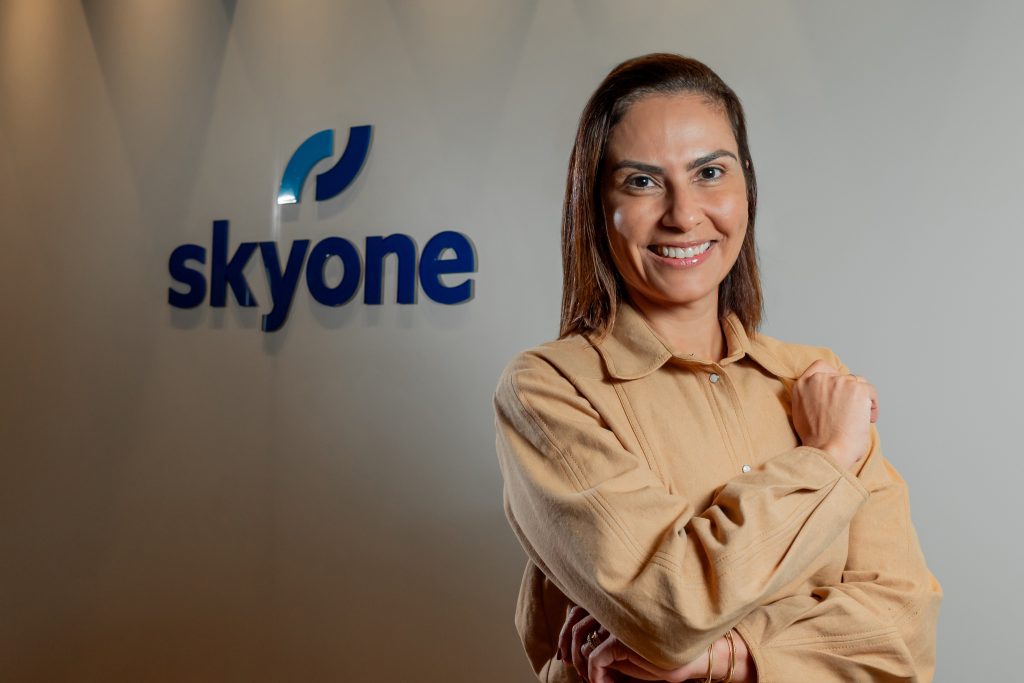
Deborah Lia reveals the behind-the-scenes story of Skyone's accelerated growth and the new role of HR
Amidst Skyone's expansion, an executive advocates for a more strategic HR approach, better prepared to work with AI; with 25 years of experience in the field, leadership is concerned about the entry of new generations into the job market. How to scale a technology company while maintaining financial discipline and operational sustainability? This was the central point of the […]
Amid Skyone's expansion, an executive advocates for a more strategic HR department, better prepared to work with AI; with 25 years of experience in the field, leadership is concerned about the entry of new generations into the job market.
How do you scale a technology company while maintaining financial discipline and operational sustainability? This was the central point of Skyone's CFO, Rodrigo Tremante's, participation in the Papo podcast
Growing rapidly without turning HR into an operational bottleneck is one of the challenges that drives Deborah Lia. CHRO of the technology company Skyone, the executive argues that the role of HR is changing profoundly: less execution, more strategic influence. "HR generates efficiency – and that goes beyond the number of people," says the Ceará native, who has been in the field for over two decades. In a sector marked by pressure for growth, the advancement of artificial intelligence, and discussions about productivity, Deborah believes that the area will have increasing relevance in business decision-making.
The vision comes from an unconventional career path. With a degree in Psychology, Deborah began her career at Beach Park, worked in education, industry, and technology companies, and arrived in the private equity world, acting as an operating partner at Aqua Capital. Along the way, she accumulated experience in cultural integration, leadership development, and inorganic growth – a repertoire that found fertile ground at Skyone, a company that, according to her, "changes every day.".
“Those who go on vacation for 30 days return to a different company,” says Deborah about the company's routine, which is experiencing strong expansion. Today, the organization has 516 employees – a 13% jump compared to the same period of the previous year. By the end of 2026, the forecast is to reach more than 600 people, in an accelerated hiring pace that demands effort from HR.
In her conversation with Cajuína, the executive discussed how Skyone has been incorporating AI agents in recruitment and selection, the challenges of accelerating the development of young professionals, and the impact of automation on entry-level positions. She also discussed mental health in high-pressure environments, leadership succession, and questions about how new generations will enter the job market.
For her, the role of HR is to act as a link between strategy and people.
Soon, interns will need to lead faster than they realize.
Deborah, how did you get into the world of HR?
I wanted to be a doctor, but I gave up and then went to study Psychology. Later, I gave up on being a clinical psychologist: when I was in my last year of college, I had many organizational psychology courses and many professors invited me to do internships. I've always liked things that are more dynamic. I even worked in a clinic after I graduated, but I realized I preferred the corporate world. In a clinic, you depend more on the other person's time and you're just a channel. Within an organization, you make a difference, in addition to setting your own pace.
One of your first professional experiences was at Beach Park – which makes many people think of fun. What was that beginning like?
It was actually quite a fun job. At first, it wasn't so much, because I didn't start in HR. During college, I interned there in multiple roles, from hospitality to the park. At the time, it was possible to intern in any role – not just in a related area. When I graduated, I was invited to set up the HR department at Beach Park, which was great because I already had experience from the other side. To this day, I have many good connections there. And it's a fun job because, at the end of the day, what you deliver is joy – so everyone needs to have the same enthusiasm and engagement to be able to deliver that.
After that, you left Fortaleza and worked in various industries. What was that journey like?
After Beach Park, I moved to Rio to attend FGV (Fundação Getúlio Vargas) and work at a technology consulting firm. Besides HR, I was also a project manager, which later led me to move to São Paulo in 2006. That's when Suzano called me to join their paper unit as a business partner. I was responsible for Brazil, the US, London, and Argentina, and it was a challenge to implement Brazilian culture within the acquired companies, creating a unique culture. I stayed there for three years and ended up having to return to Fortaleza due to personal problems. There I met Carlos Degas Filgueiras, because he was the president of DeVry, an American education company. He invited me to work at the company, now known as Adtalem, with the opposite challenge: to implement the culture of an American company within a Brazilian operation. I stayed there for ten years.
It was quite a long experience. What were the main challenges?
My mandate has always been to strengthen the culture and develop talent so that we could grow in a business that had a lot of inorganic growth. At the same time, we didn't always have the best salaries, so the challenge was to create a unique culture with a subsystem of internal talent. Every time we made an acquisition and the owner didn't stay in operations, we brought someone from the promotion list to take over operations. This made the culture very strong. That's what we did, for example, in the acquisitions of Damásio de Jesus and Ibmec in São Paulo. Another challenge was dealing with the disparity in the teams. On one hand, you have people in the back office with a basic level of education, while on the other hand you have employees with master's or doctoral degrees.
After Adtalem, you went on to work in private equity. That's an unusual career path for someone in HR. How did that happen?
It was something completely different from anything I had done before. Aqua Capital, where I went to work in 2019, was a school – especially because private equity is the opposite of anything else. It's a model where you need to work a lot on influence. I was an operating partner in an ecosystem with more than 20 companies. My goal wasn't to create a single culture, but rather to strengthen each culture, helping each HR department generate value through people – and thus allowing investors to make money. In other words, it wasn't just a people and management process; it involved more than 20 companies, according to the maturity of each investment. I worked with companies ranging from those preparing for IPOs to those in bankruptcy proceedings. I think it was an experience that helped me a lot when I came to Skyone.
How was your career going when you received the invitation to join Skyone? What were your professional aspirations at that time?
When I left private equity, I wasn't sure I wanted to leave that world. I love private equity – and I still think it's crazy, but it's also very cool. It depends on each person and each moment. My personal life is more organized because my husband is a civil servant, so he can take better care of the house, my daughter, and family matters. I, on the other hand, have a freer life to manage this crazy professional life, but I don't think everyone can do that all the time. Besides, there aren't that many private equity firms in Brazil – and even fewer People professionals in that type of company.
So, I started looking at which industries I wanted to return to. An important characteristic is that they should be invested in by private equity or venture capital, due to their governance and growth vision. At the same time, I wanted to regain the power of final decision-making.
At that time, I received two offers. Degas, from Bewater, invited me to join Skyone. And, at the same time, Warburg Pincus invited me to join Superlógica. I ended up going to Superlógica in 2024, but it wasn't really my thing: they were more focused on operational efficiency review, less on growth. And then I ended up accepting the offer from Skyone, as part of the Bewater offer. Initially, I was helping to close the position, and then they convinced me to join instead of helping.
It's been two years since you joined Skyone. What kind of company did you find when you first arrived?
It was a company with four founding partners, aiming for rapid growth. Even though we're a service company, the company experienced a lot of change every day. When I arrived, there were few processes and little governance, and that was my first challenge. I love working here because no two days are the same. Anyone who goes on vacation for 30 days comes back to a different company.
I always say in the selection processes that Skyone is a good company to work for if you want to grow with us. We'll never be a Unilever, with super-rigid governance and processes, but we also don't want to be a family business where informality reigns. We're in the middle ground – we need to be formal, but without losing the informal touch. In practice, this means that processes can't be bureaucratic or hinder growth. How do we do this? By seeking people who have experience both in places where processes are important and in startups. That's why recruitment and selection remains our biggest challenge.
Skyone is a technology company. How do you manage to keep HR from being a "cobbler's children go barefoot" kind of company?
It's a challenge. We have a really cool recruitment and selection case study that shows how much progress we've made. I've already mentioned that this is my Achilles' heel. Last year, we didn't want to hire new recruiters, but we also had a large volume of vacancies to continue growing rapidly. I realized there was a bottleneck. I sat down with the product team and said that we needed to create agents to do the search and screening, considering three phases of the process. They said they didn't have the people.
We hired two interns, trained and developed them – one for HR, the other for product. In three months, we were able to launch the product, with three integrated agents. As soon as a vacancy opens, the first agent uses the ATS systems and searches for profiles across all platforms. A second agent sends culture tests to these profiles. The results are passed on to managers, who make a selection. If there are at least four interesting profiles, another agent conducts the second interview. Part of the process even takes place within WhatsApp, conversing with candidates in the same way a recruiter would. I think it's an example that shows that the solution isn't made of wood. Of course, we still have a lot to improve, but we already have many great things happening.
It's an interesting story because it shows not only the solution, but also the creation of a culture linked to AI. How do you foster this culture among employees without passing the problem on to other areas – such as product and technology?
My team has the opposite problem! Here, people are so keen on AI that we need to put the brakes on, even for security reasons. My main dilemma today is that my employees really want to use ChatGPT or Claude to solve problems, but security is hindered by data policies. What we're doing to solve this challenge is using Creator, a product we offer to clients that has a world of AI capabilities but allows us to work with sensitive data. We're working with the product and security teams so we can advance even further in this direction.
It's very easy to get excited about new things. At the same time, there's so much information that it's hard not to feel a certain amount of mental health pressure. How does Skyone, being a technology company, address this?
Mental health was already an issue even before artificial intelligence became popular. That said, we are a fast-growing company where the pressure for results is very strong. We work a lot on resilience in our selection processes, for example. We just completed a risk assessment report for NR-1 (Brazilian Regulatory Standard 1) and I'll tell you this: artificial intelligence can generate pressure to deliver more, but it's not what will make you more or less ill. It's much more about how you deal with the daily pressure, which can come with or without AI. We have a constantly evolving environment, and what I try to do is keep my team very close to the different areas, to understand when people are going through difficult times.
Our organization is more in-person than remote, which helps, but we also need to develop managers so they are aware of mental health issues, and so that monitoring tools don't become tools for measuring productivity. On average, out of eight hours a day, people are productive for six hours. When we see that people are productive for longer periods, working seven or eight hours, I get worried – especially because we are experiencing an increase in headcount. In other words, we are increasing teams and yet people are being used more than necessary. It's a painstaking task to understand what's happening, talk to managers and show them that this is a problem. At the same time, we try to give managers tools to think about this, because their priority is to solve the technical aspects.
It's interesting that you mention Skyone has been experiencing an increase in headcount. It's a hot topic in the tech market, which has been going through many layoffs – and, in particular, the dismissal of middle management. How has Skyone viewed this trend?
I've seen many reports about this and I have a different perspective. Here, we've promoted far more people to management positions than the other way around. The problem for us lies at the lowest level of the pyramid, with the analysts. Much of the work in these positions can be handled by agents – who will be supervised by coordinators, managers, and directors. Today, I have all three levels here, partly because it's necessary to generate succession plans. When I arrived, I found a management team full of technicians promoted to coordinators, which is a common problem in many companies. To solve this, we adopted a leadership program , aiming to transform at least 70% of coordinators into managers in the future, and managers into directors. Obviously, there won't be a position for everyone, but inorganic growth helps us in this regard.
Replacing analysts with agents can create a gap in the company's succession pipeline over time. How have you approached this issue, given that you can't hire someone fresh out of college to be a coordinator, for example?
Our approach involves providing experience for younger professionals. Today we have a large pipeline of analysts who will grow into coordination roles. At the same time, we have a very well-organized internship program here, focusing more on soft skills than hard skills. Why? Because soon, these interns will need to lead faster than they imagine. Our interns and young apprentices have very accelerated programs – and we want to do the same with trainee programs, so that the acceleration is even faster. At the same time, I worry about future generations; will my daughter have a job when she graduates? That's my biggest concern.
At the leadership level, we will always need people with both technical and soft skills. Emotional intelligence will be increasingly necessary. But this gap is a real challenge.
What other challenges do you see for HR, Deborah?
There's a topic that few people talk about: "ramp-up time," that is, the time it takes for a person to start producing after joining the company. It's a very sensitive topic, especially for expanding companies, because it can generate two frustrations – both on the employee's and the manager's side. If a person joins and doesn't deliver results quickly, it's easy for the company to think they didn't make the right choice, which directly impacts turnover costs. The same applies to the employee. And what worries me is that in each area, this happens differently – and we need to be attentive to these trends.
At Skyone, for example, we want to grow significantly by 2026, and for that, the sales area will be fundamental. We're bringing in a lot of people, but it's not enough to just bring them in: how do we get people to deliver faster within their area? We changed our entire onboarding process, focusing on people and connections, so that people could take shortcuts and advance. It was a collaborative process, uniting HR, sales, finance, and operations, all working together so that salespeople could deliver faster. We were even able to measure the impact: before, a salesperson took 4 to 5 months to make their first sale.
Today, we already have salespeople who make their first sale in the first month – and that's good for everyone, including the employee, because they receive variable compensation right from the start. Our challenge now is to do the same process for other areas, also embracing the use of automation. In other words: it's not enough to just do things differently, but also to create ways to make the work less stressful.
What kind of HR do you expect to find in five years?
We will have HR professionals who influence more than they act. Looking at my experience as an operating partner, HR is much more about influencing strategic decisions than being an operational person. In other words, HR generates efficiency – and doesn't just reduce or increase headcount. The operations area itself can do that; it will have the intelligence. But this allows HR to grow because it will increasingly influence the business. For this to happen, HR also needs to change: the CEO will only bring them to the business table if they see added value in HR, but they also have to give HR space to show itself.
Finally, do you have any reading or podcast suggestions?
One book I love is * Who: The A Method for Hiring*, by Geoff Smart and Randy Street. It's a book I brought from Aqua and take everywhere because it's incredibly helpful in creating a hiring methodology. Every manager thinks they have their own way of hiring – and that their way is the best way. But when you create a method, not necessarily a better or worse one, it's a chosen method, and people have to follow it. It seems subjective, but it ends up making a big difference in day-to-day work.

Start Your Digital Transformation Today
Transform Your Business with Skyone. Request a demo or schedule a call with our experts to discover how Skyone can accelerate your digital strategy.