



For your team


Migrate to Skyone


Featured products


Ecosystem and collaboration







Systems integration: what is it, what types are there, and how does it work?
The continuous advancement of technology and the increasing complexity of information systems means that organizations face the challenge of managing multiple digital tools simultaneously.
Ultimately, as a company grows, it's natural for processes to become increasingly bureaucratic and complex, and as time goes on, the manual work involved in updating information and systems becomes practically unfeasible.
This implies the need to create a cohesive ecosystem , in which sales, inventory, finance, and human resources systems, for example, can share data and information efficiently.
This is achieved through what we call systems integration , an essential strategy for companies seeking to optimize processes and improve communication between different technological platforms. It consists of connecting different systems and software to cooperate, functioning as if they were one.
Increased public and private investment in systems integration solutions to enhance their Information Technology (IT) infrastructure is driving the growth of this market worldwide.
According to research published by Grand View Research global market for system interaction is expected to grow at a compound annual growth rate (CAGR) of 13.8% from 2023 to 2030.
Among the benefits of this strategy, the following stand out: improvements in operational efficiency , reduction of errors due to manual data entry, and the ability to provide a unified and up-to-date view of the business for more informed decision-making.
In this article, we will understand in detail what systems integration is, its types, the benefits it brings to the various areas of the company, and its role in digital transformation.
What is systems integration?
Systems integration is a technology strategy through which companies optimize their internal processes. It promotes the centralization of information , which contributes to an improved experience for both customers and employees.
This method allows different information systems to communicate efficiently and in real time, sharing data and resources.
System integration is important because each software is programmed with a different coding style, and it acts as an intermediary that translates the data from each software behind the scenes. This ensures that all components work together harmoniously to preserve productivity.
The information exchanges include customer data, orders, accounts payable or receivable information, etc., making it possible, for example, to integrate all systems , from a CRM with the ERP, to the e-commerce platform with the tax system. This allows the company's departments to become more interconnected.
How did systems integration come about?
Systems integration is rooted in the continuous evolution of information technology and the growing need for organizations to make their systems more interconnected and efficient.
Initially, in the 1960s and 1970s, when mainframes were predominant, integration involved connecting these centralized systems. With the adoption of distributed systems in the 1980s and 1990s, the challenge of integration increased, leading to the emergence of middleware to facilitate communication between diverse platforms.
The development of standards such as XML and SOAP in the 1990s, along with the rise of web services and SOA in the 2000s, introduced a more modular and flexible approach to integration.
Historically, as organizations began incorporating various systems to manage their operations – from sales and inventory to finance and human resources – it became necessary for these systems to be able to communicate with each other in an automated way.
Currently, cloud computing drives solutions such as iPaaS (Integration Platform as a Service), providing cloud-hosted tools for agile and scalable integration , meeting the complex demands of modern organizations.
This not only improved operational efficiency but also optimized decision-making, since integration provides a unified view of business activities based on concrete information.
What is the difference between systems integration and data integration?
It's very common to confuse systems integration with data integration. Both are fundamental to improving operational efficiency in modern companies, but they don't refer to the same process .
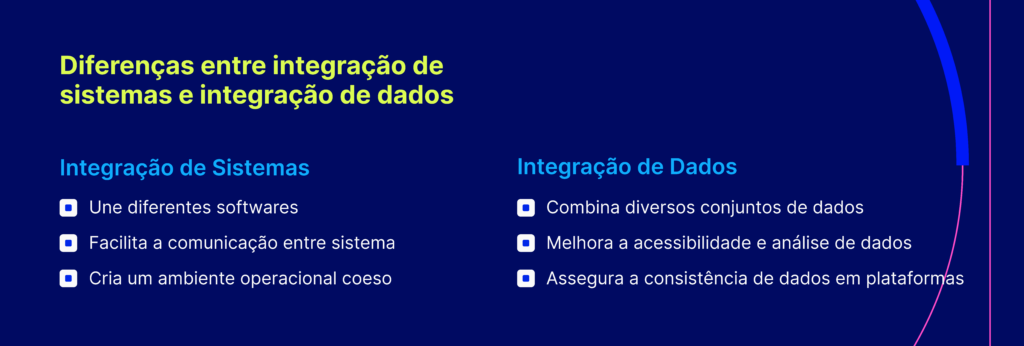
Systems integration focuses on connecting different software systems , enabling them to work together. Its goal is to create a collaborative environment where systems can communicate and operate as a cohesive unit.
This simplifies business processes by providing a unified view of how the company operates. In practice, systems integration may involve data sharing, but its scope is broader.
On the other hand, data integration deals specifically with the handling and combination of data from multiple sources . The process aims to unify information, typically within a database, so that it can be more easily accessed and analyzed. Data integration focuses on ensuring that data quality and consistency are maintained across all platforms.
To make it easier, we have listed below the main differences between the two strategies:
Both processes are vital for digital transformation, but each has its specific role with regard to the management of information and technological resources of organizations.
How does system integration occur?
In the past, systems integration used to be a complex task. Systems and applications from different providers required a point-to-point integration solution, relying on complex configurations and custom coding.
This format has proven to be inflexible and fragile, as well as requiring constant maintenance, since each software update or change in the process can affect the entire integrated system.
Today, the most robust integration solutions are already a reality. This allows new technologies such as cloud computing, Big Data, and IoT to communicate rapidly with each other and with existing systems.
A good integration platform as a service generates, as its main internal benefit, the centralized management of all integrations between the business's software, with real-time data processing, mitigating time spent on rework, data loss, and system instability.
The methods for achieving this integration vary, but generally involve the use of APIs (Application Programming Interfaces) or middleware , software that acts as an intermediary layer between different applications, systems, or components, facilitating workflow across platforms.
System integrations can occur in two ways: unidirectional and bidirectional. Below, learn more about each of them.
Unidirectional
In one-way systems integration, information flows in only one direction, that is, from a source system to a destination system . In short, it consists of one system sending information to another but not receiving anything from it.
For example, sales information can be sent from the point of sale to the inventory management system.
This approach is simple and reduces the complexity of the operation, but it may not be sufficient for processes that require two-way communication.
Thus, the main advantages of unidirectional integration are implementation complexity reduced risk of data conflicts . The main disadvantage, however, lies precisely in its limitation: it is only recommended in scenarios where there is no need for data return.
Bidirectional
Conversely, bidirectional integration allows data to move in both directions between integrated systems . This exchange can occur synchronously or asynchronously through APIs or middleware solutions, creating an ecosystem of applications that both receive and transmit information.
This happens, for example, in a business environment where there is a need to integrate a customer relationship management (CRM) system with a marketing automation system.
This bidirectional integration allows for a continuous exchange of data between the two systems, ensuring that relevant information is always up-to-date on both platforms.
Bidirectional system integration has two main advantages real-time (or near-real-time) synchronization and greater data consistency and integrity. On the other hand, its main disadvantage is its more complex implementation, which requires greater management capabilities.
What types of system integration exist?
There are several ways to integrate systems, such as electronic data exchange, the use of shared databases, the implementation of APIs, as well as horizontal and vertical integration models.
Each method has its own particularities, advantages, and disadvantages, which highlights the importance of understanding the specific needs in order to choose the most appropriate solution.
System integration types have evolved to facilitate communication and data sharing between different technological platforms. They are essential for companies seeking efficiency, scalability, and information security.
Currently, there are five most common types of system integration: via API, legacy system integration, via database, via big data, and integration with cloud services.
Learn the details of each one:
Via API
API (Application Programming Interface) integration facilitates communication between independent systems . APIs stand out for their flexibility and efficiency, allowing systems to share functionalities and data in real time.
Although there are several subcategories of APIs, including public and private, they all aim to connect systems . By establishing these interconnections using a common coding language, systems can transmit data between them.
Integration of the legacy system
Legacy system integration refers to upgrading legacy systems , often by creating bridges between outdated technologies and modern systems.
This approach is essential for organizations seeking to innovate without completely replacing their existing infrastructure . In short, it allows the organization to connect legacy systems to newer systems.
Via database
Database integration occurs when different systems access and modify information directly in a common database . It requires careful access management to ensure data integrity and security.
For it to work, you need to use data extraction software.
Via Big Data
Data integration via Big Data involves integrating systems that handle large volumes of data and require high processing capacity.
Big Data project because it allows the integration of data from various sources and in different formats . This way, you can combine all the data into a single visualization for use in reporting and analysis.
In this case, Big Data is fundamental for analyzing complex information and supporting strategic decisions based on data.
Integration with cloud services
Integration with cloud services offers scalability and flexibility, allowing systems to share resources and data across cloud-based platforms .
It connects various applications, systems, and databases to be integrated into cloud services, allowing access from multiple devices on a network or connected to the internet.
Single Sign-On (SSO) solutions are commonly used in this type of integration to simplify user authentication across various services.
Each approach has its merits, and the choice of which one to use needs to be based on factors such as cost, efficiency, and the organization's strategic objectives.
| Integration Type | Main Advantage | Recommended Cases |
| Via API | Ease of communication between systems. | Fast and efficient integration between applications, microservices, and web platforms. |
| Legacy System Integration | Preserving investments in existing systems | Environments with essential legacy systems, allowing for gradual modernization without the need for complete replacement |
| Via Database | Efficient transfer of large volumes of data | Integration between systems that share structured data, such as relational databases, to support ETL or replication operations |
| Via Big Data | Scalable processing and analysis of large volumes of data | Environments that handle large amounts of unstructured data, such as logistics, IoT, and advanced big data analytics |
| Cloud Services | Flexibility and scalability in virtualized environments | Companies that utilize cloud services, enabling the integration of applications, storage, and distributed processing in cloud environments |
What are the benefits of systems integration for businesses?
Adopting integrated systems offers a range of benefits, from increased efficiency to significant improvements in decision-making and productivity.
Furthermore, companies that adopt this strategy can expect not only cost reductions , but also a wide range of other competitive advantages, such as:
Operational efficiency
Systems integration improves organizational processes, making them more agile and reducing the occurrence of errors. This translates into more efficient operations and a more rational use of available resources.
Successfully integrating systems can be crucial in saving employees time, as it reduces manual tasks and thereby increases productivity.
Improved decision-making
centralizing data from different departments , the company gains the ability to analyze information across all sectors, resulting in more informed and strategic decisions .
Because of its ability to use accurate and complex data in an automated way, it provides a 360° view of the organization. This allows for better and more precise decisions to be made, enabling organizations to grow and reduce their operating costs.
Cost reduction
Integrating systems can eliminate redundancies , which consequently optimizes resources. This leads to a significant reduction in operating expenses.
automated workflows , ensuring greater efficiency in processes and drastically reducing error margins.
Increased productivity
Integrated systems automate repetitive tasks and allow employees to focus on higher value-added , thus boosting organizational productivity.
Improved customer experience
Consistent and accessible information significantly improves customer service, resulting in faster and more accurate responses .
Real-time business monitoring
Integration allows for real-time of different areas of the company, enabling a quick response to any operational adjustment needs.
Collecting all data in a central system optimizes business analysis, ensuring the reliability of information and increasing its added value.
Improved internal communication
A unified platform facilitates communication between departments, promoting greater cooperation and a shared understanding of business objectives.
A clear example is the connection between all of systems and its ERP , which then provides the administrator with a more complete view of the business.
Centralized security management
With systems integration, information security is managed centrally, strengthening protection against external threats and reducing vulnerabilities.
Unified data management
Centralizing data promotes its consistency, quality, and availability, making it more reliable for analysis and reporting.
Through system integration, managers can more easily manage the entire volume of information and gain insights for decision-making, even using a single interface, which optimizes time and contributes to their productivity.
An alternative to replacing the legacy system
Integrating modern systems offers an alternative to legacy systems, which are often inefficient and expensive to maintain.
Integrating data from legacy systems with modern systems allows organizations to continue working with them and keep advancing in their digital transformation .
What are the step-by-step instructions for implementing systems integration in companies?
Implementing systems integration in a company requires a detailed plan that guides the organization through several critical steps. Each phase must be meticulously planned and executed to ensure a smooth and effective transition between different systems.
You might be wondering how, exactly, to identify the signs that it's time to implement systems integration in your company?
Observing operational problems, inefficiencies, and specific challenges in a company's processes often indicates the need to consider systems integration as a solution to improve the overall efficiency and effectiveness of the business.
If you've determined that it's time for your company to implement systems integration, check out the suggested step-by-step guide below on how to do it.
Planning
The first step toward successful systems integration is strategic planning. Companies must define clear objectives and establish an initial focus to guide the process and evaluate its success later.
This planning includes process optimization, where the company's needs are identified and how integration can meet those requirements is determined.
Development
During development, the tools and approaches to be used in the integration are selected.
This step involves choosing appropriate technologies and designing a robust and scalable integration architecture. Ensuring compatibility between the systems to be unified is also essential.
Tests
During the testing phase, integrated systems are rigorously tested to ensure they function as expected. Performance and security tests are crucial to verify the resilience of the integrated system.
Companies should test all possible scenarios to identify and correct flaws before implementation.
Implementation
This is the stage of putting the integrated solution into operation . It is crucial that there is a smooth transition, without interrupting business activities. The company must be prepared to resolve unforeseen events that may arise during this stage.
Improvements
After implementation, the continuous improvement process begins. Systems integration is an ongoing effort that requires regular updates and adjustments to maintain the efficiency and relevance of the adopted solutions.
Continuous feedback and monitoring are essential to identify opportunities for optimization and evolution of the integrated system.
Each step is essential to ensure that systems integration is implemented effectively, promoting cohesive data management and maximizing organizational performance.
Why is iPaaS the best way to integrate systems?
As we mentioned earlier, iPaaS stands for "Integration Platform as a Service." It 's a category of cloud services that offers tools and resources to facilitate the integration of different systems and applications within a company.
The goal of iPaaS is to enable organizations to efficiently and automatically connect systems that, otherwise, could only operate in isolation.
Because it's a cloud-based solution, iPaaS generally has a lower cost compared to purchasing software licenses, which used to be the most common way of integrating systems in the past.
In this sense, iPaaS emerges as a modern and efficient for systems integration, offering significant advantages in terms of ease of use, speed of implementation, scalability, connectivity, simplified maintenance, cost-effectiveness, and security.
It is important to emphasize that, in practice, systems integration can be challenging if performed in an outdated way, without the support of an integration platform . Integration projects that go wrong can have far-reaching consequences, even resulting in connections that cripple the IT infrastructure.
Below, we detail the main advantages of iPaaS as a way to integrate systems:
Ease of use
iPaaS is recognized for its intuitive and user-friendly interface , making system integration an accessible task even for those without advanced technical knowledge.
With visual and drag-and-drop tools, users can create integration flows without the need for extensive coding. This simplified approach democratizes the integration process, allowing multidisciplinary teams to collaborate effectively.
Fast implementation
One of the most striking features of iPaaS is its agile implementation capability. By eliminating the need for extensive development and manual coding, organizations can significantly reduce the time required to implement integration solutions.
The speed of iPaaS implementation is crucial for quickly adapting to changing business requirements and maintaining a competitive edge.
Scalability
iPaaS is designed to scale as the organization's needs grow. The flexibility it offers allows companies to efficiently scale their integrations, handling increasing volumes of data and more complex demands.
This inherent scalability ensures that the integration solution remains effective regardless of the size or expansion of the company.
Pre-built connectivity
One of the great advantages of iPaaS is the presence of pre-built connectors for a wide variety of applications and systems.
This means that organizations can save time and resources by using connectors that have already been developed and tested for specific integrations.
The extensive library of connectors available in iPaaS simplifies the integration process, allowing companies to focus on more strategic objectives.
Simplified maintenance
Continuous integration maintenance is optimized with iPaaS. Automatic updates, proactive monitoring, and troubleshooting simplify daily operations.
Cost-benefit
iPaaS stands out for its cost-effective model, providing organizations with a flexible and efficient financial approach. With pay-per-use , companies avoid significant upfront investments, paying only for the resources consumed.
Furthermore, by migrating to cloud-based iPaaS, the costs associated with physical infrastructure are eliminated, providing substantial savings.
Automating integration tasks also contributes to operational efficiency , optimizing human resources and providing tangible financial benefits.
Security
Security is a central priority in iPaaS, ensuring comprehensive protection for data and operations.
The implementation of advanced protocols , such as robust encryption for data at rest and in transit, ensures the confidentiality and integrity of information.
Granular access controls allow organizations to define who has access to which data, minimizing the risks of unauthorized access. Furthermore, iPaaS adheres to rigorous security standards, such as ISO 27001 certification , ensuring compliance with industry regulations and norms.
This robust and security-focused approach inspires confidence in the integrity of the integration environment, making iPaaS a reliable choice for companies concerned about data protection.
Future trends in systems integration
The constant evolution of information technology continues to shape the landscape of systems integration, with several trends promising to transform how organizations interconnect and operate their systems in the future.
One of these trends is the growing adoption of microservices architectures , which break down monolithic applications into smaller components, making maintenance, scalability, and integration easier.
The cloud will continue to play a central role , with the emergence of systems integration solutions fully based on this technology, such as Integration Platforms as a Service (iPaaS).
Artificial intelligence ( AI) and other emerging technologies are appearing as significant drivers , promoting smarter and more autonomous integrations. The ability of systems to self-adjust, learn from usage patterns, and anticipate integration needs will be increasingly valued, providing operational efficiency and real-time adaptability.
Artificial Intelligence (AI)
AI has emerged as a catalyst in systems integration, offering advanced automation and intelligent insights. It is the driving force behind many advancements in systems integration.
Its application promotes process automation and agile decision-making, with systems that learn and adapt automatically. AI-powered integration systems can learn usage patterns, anticipate scalability needs, and dynamically adapt to changes in business requirements.
The ability to process large volumes of data in real time drives operational efficiency and provides a smarter, more adaptable integration experience.
Companies that use AI in systems integration can expect improvements in operational efficiency and more personalized customer service.
Edge Computing
Edge computing represents a shift from traditional computing architecture. It's a data processing that occurs closer to the source of data generation or consumption, that is, at the "edge" of the network.
Instead of sending all data for processing to remote servers or the cloud, edge computing decentralizes some of that processing, allowing it to occur locally, close to the devices or systems that generate or consume the data.
In systems integration, edge computing reduces latency by processing data locally, improving the efficiency and speed of operations. This is particularly crucial in scenarios where real-time response is essential, such as in industrial and IoT applications.
The ability to integrate systems in a distributed manner, leveraging local processing power, strengthens the resilience and agility of integration solutions. Businesses that integrate Edge Computing can better manage large volumes of data and accelerate insights .
IoT devices
The Internet of Things (IoT) refers to an interconnected system of physical devices, vehicles, appliances, and other objects embedded with sensors, software, and network connectivity, enabling them to collect and exchange data with each other.
The essence of IoT is the ability of these "smart" objects to collect and share information about their environment and interact with each other , often without the need for direct human intervention.
In the context of systems integration, Internet of Things (IoT) devices are fundamental for data collection in a variety of contexts. The integration of these devices facilitates the monitoring and control of operations in real time.
It introduces a multitude of new data points and connected devices. The efficient integration of these heterogeneous devices is crucial to harnessing the full potential of IoT. Furthermore, the collection and analysis of data from sensors and IoT devices provides valuable insights for optimizing operations and driving data-driven decision-making.
Systems integrated with IoT can offer a 360º view of business performance, enabling continuous optimizations and more efficient asset management.
The role of systems integration in digital transformation
Digital transformation represents a fundamental restructuring of companies' operations, strategies, and business models, driven by the use of digital technologies. In this context, systems integration emerges as an essential pillar.
It enables different digital platforms and tools to communicate efficiently, facilitating process automation and data-driven decision making.
Systems integration facilitates the adaptation of companies to new technologies, ensuring an agile technological environment that is responsive to market changes.
In turn, integrated systems provide a consolidated view of the business, enabling quick and assertive actions. This speed and precision increase the competitiveness of organizations in the market.
Horizontal and vertical system integration is a practical example of this application. Horizontal integration refers to communication between systems at the same hierarchical level, while vertical integration focuses on communication between systems at different levels.
Within the context of Industry 4.0, this strategic integration is crucial for the application of high technology in manufacturing , directly impacting operational efficiency.
The approach to systems integration should be designed to reflect the objectives of digital transformation, always focusing on increasing efficiency , continuous improvement, and meeting market demands.
With systems communicating harmoniously, companies become more flexible, intelligent, and future-ready.
How can you ensure the best systems integration for your company?
To ensure the best systems integration within a company, one must begin with strategic planning . Defining clear objectives is essential.
For example, these objectives might be to save time, improve process quality, or reduce costs. A careful analysis of needs and challenges will guide the entire integration process.
First Steps
- Define objectives: focus on measurable goals that reflect the company's needs;
- Choosing the right technology: find suitable solutions that align with the company's objectives;
- Technology and Partner Selection: Factors such as performance and scalability should be considered when choosing technology. It is also important to select partners, such as Skyone , that offer reliable integration platforms that are suitable for the size and complexity of the existing infrastructure.
Implementation and Training
When technology is implemented, proper user training is necessary to ensure that the team can maximize the use of the new tools. This is essential to achieving the desired levels of efficiency and performance.
Maintenance and Monitoring
continuous monitoring and maintenance should be established to ensure that the integrated systems maintain high-quality performance.
Constant evaluation allows for the rapid identification of adjustments needed to ensure the stability and efficiency of integrated systems.
Easily integrate your systems with Skyone
In the journey of systems integration, finding a technology partner that can offer a robust yet simplified solution is fundamental. Skyone stands out as this ideal partner , bringing to market an iPaaS solution that allows you to connect different systems and applications efficiently , securely , and scalably .
Even without in-depth technical knowledge, your team can create and manage system integrations in a visual and intuitive way. Through a user-friendly interface , it's possible to drag and drop components to configure workflows, establish connections between applications, and easily automate processes.
Learn how our platform can simplify your integration routine!
Conclusion
systems integration strategies represent a critical aspect for strengthening the operational efficiency of companies. They enable an agile and reliable flow of information between different departments, contributing enormously to the long-term sustainability of the business.
Investing in this technology is a strategic move that often results in savings of resources and time . A unified and well-structured system allows for more accurate data analysis, as well as promoting process automation.
Take advantage and discover more about the benefits of iPaaS in the world of integrations!

Start transforming your company
Test the platform or schedule a conversation with our experts to understand how Skyone can accelerate your digital strategy.