



For your team


Migrate to Skyone


Featured products


Ecosystem and collaboration








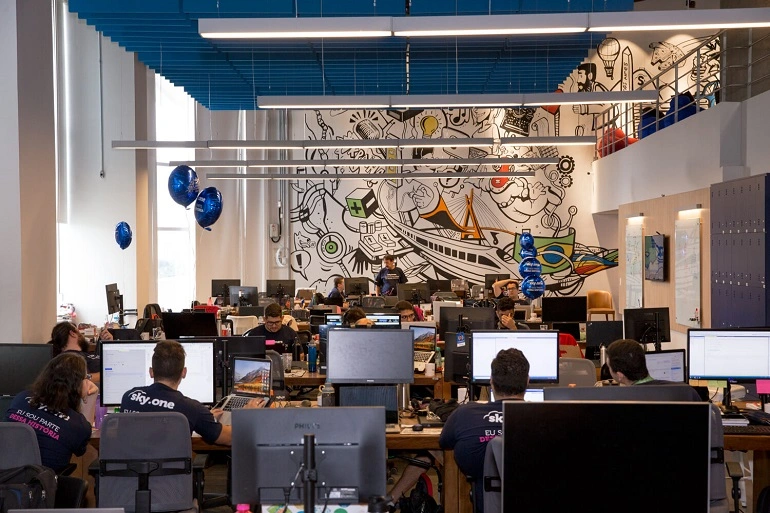

Walter Longo: In the metaverse, it's time to learn and collect data
It's difficult to predict whether the metaverse is just a hype or a definitive trend that everyone will join sooner or later. But, for Walter Longo , it's already something important that deserves the attention and knowledge of technology professionals and leaders in companies. This implies studying the subject and "not waiting," that is, conducting tests and leading innovation projects that guarantee a presence should the metaverse actually take off.
“And understand that at this moment it’s not ROI [return on investment], but ROL, with L for Learning. Learning and collecting data”, says the innovation and digital transformation specialist – and main attraction of Sky.One Connect , an event that takes place this Tuesday (14) in São Paulo, capital – IT Forum
Longo is an advertising and business administration professional by training, with postgraduate studies at the University of California. He is also a speaker and managing partner of Unimark Comunicação, a company he leads – although he is best remembered for his time as CEO of Editora Abril .
According to him, establishing the metaverse faces two major technical challenges. First, the lack of interoperability , which makes the transfer of items and interaction between users on different platforms impossible. And second, the high latency , which prevents broader, deeper, and more massive interactions.
“We are back to the early days of the internet,” the expert recalls, mentioning the different email servers that didn't communicate with each other. “Until the WWW emerged, a common language protocol.”
Check out the highlights of the chat below.
IT Forum: Your talk at Sky.One Connect is about the metaverse. What do you plan to present?
Walter Longo: I recently conducted a fairly comprehensive study on the social and corporate consequences [of the metaverse]. The topic will be Metaverse: one day you will live and work there .
In it, I show some trends that were already occurring and were exacerbated by the pandemic, leading to a natural and exponential growth of the metaverse.
IT Forum: What trends?
Longo: First, the habit we all acquired, a test drive we had, of digital presence on social media. Everyone wants to be happier and more joyful on social media. And that was training for the metaverse. Second, we learned to be far away and close at the same time. These tools we are discussing here [video conferencing], were previously restricted to a smaller group and are now accessible to the entire population. The third reason is that society seeks a more inclusive world, with equal opportunities and possibilities.
And [the metaverse] seems like a promise of a more democratic world, too. All of this attracts people of all kinds. In the [book] Snow Crash, [author] Neal Stephenson used the term for the first time and showed that deep down a pizza delivery guy could be a warrior. It's an irresistible attraction.
IT Forum: And what are the implications of the metaverse for the corporate world?
Longo: Brands are desperate to claim their share [of the metaverse]. The main reason is that there has been a shift in corporate purpose. Ten or fifteen years ago, when I went to a board meeting and presented an idea, the question was whether it fit the business.
“Let’s focus on our business, let’s not go too wide because focus is fundamental.” More recently, people have started talking not only about what business they are in, but what problem they are solving. This has already made the corporate purpose more comprehensive. It no longer mattered what I did, but what problem I solved. More recently, we have moved on to “what dreams will we fulfill?”. It is an even more comprehensive corporate proposition, and that's where the metaverse emerges as this possibility of fulfilling customers' dreams. And this has generated an impressive rush of brands and products going to the metaverse.
The most important brands are holding fashion shows in the metaverse and selling clothes, bags, and shoes. People are buying things to go to a party, to meet friends, through a digital twin. And while they are launching incorporeal products, they are also selling things for the physical world. I go into a store in the metaverse, buy a pair of sneakers, and the salesperson asks if I want a digital or physical version. It's a major revolution that's emerging in retail.
IT Forum: Walter, our readers are primarily IT professionals and leaders who are currently wondering how they can make this vision, which is primarily a marketing vision, viable.
Longo: There's still a big question mark ahead of us. It's what we call interoperability. There are hundreds of worlds, each with its own cryptocurrency, capacity for events, shows, programs, purchases, etc. But we still don't have interoperability between these various worlds. If I buy a Fortnite t-shirt, it won't go to Roblox.
We're back to the early days of the internet, with the same vulnerabilities as back then. If I sent an email to a college classmate, it couldn't be received by a company. Then came the WWW, a common language protocol. What's currently under scrutiny is the speed at which interoperability will be implemented, the language, the model, etc. Some worlds are creating APIs for other worlds. I've seen avatar-building tools that allow that outfit to go to three or four worlds. But these are still initial exercises.
Another issue is latency. This bothers many people in IT. We still have limitations. If I do a show for a million people, it's possible, but 40 or 50 still can't look at each other. And 5G is coming to solve this problem. I believe these two challenges are the two that are currently being resolved.
IT Forum: Could these two problems somehow prevent the metaverse from evolving? Could it simply not take off?
Longo: The answer is that it can happen. But there are some fundamental differences from previous experiences like Second Life, for example. You would enter with a crude avatar that wasn't you, but that represented you. It would walk around other people making a little speech bubble, meaning there was nothing to do. After 40 minutes you would leave. Today it's very different. I bought a plot of land on Upland [a metaverse platform based on NFTs]. I built my house. Then I rented it out. Now I receive rent. I bought a plot of land that doesn't exist, built a house that doesn't exist, rented it to someone virtual, and now I'm receiving money that exists. And someone now wants to buy my house for double the price.
When I tell this to someone less knowledgeable, they think it's a madhouse or a circus. It seems crazy to pay $4,000 for a bag that doesn't exist, or $69 million for an NFT painting. We've seen unbelievable things. But all of this is hype . When someone pays millions for a digital painting, they're probably not just thinking about the piece itself, but about the hype and media attention it generates. To the point that I'm commenting on this now.
It's very difficult to predict whether it's a passing hype or something permanent. My observation is that it's something important, big, and that deserves the attention of IT professionals. Studying this subject, following it with a mindset that I summarize in one sentence: don't wait. And understand that at this moment it's not about ROI [return on investment], it's about ROL, with an L for Learning . Learning and collecting data.
IT Forum: We've heard from experts at the IT Forum who believe that corporate metaverse initiatives now need to be viewed as innovation projects. Do you agree?
Longo: Yes. But [innovation] is multidimensional. What can I do in the metaverse today and already see results? Set up a store in a shopping mall and sell products, which I can sell to an incorporeal avatar or have delivered to the person's home. I can advertise on the streets of a city in the metaverse. Create gamification programs with employees, increasing their productivity. Sell immersive glasses, haptic suits, joysticks, etc.
It's possible to have schools in the metaverse, with immersive classes. Or to set up an advertising agency to create campaigns. Or a law firm to handle any legal issues. Or architectural firms that help people design houses in the metaverse. The possibilities are endless, and with one advantage: a store in the Iguatemi [shopping mall] costs millions, while in Avakin Life it costs thousands of reais at most.
My suggestion for everyone. I would summarize it in one sentence: hold God's hand and go for it. And if it goes wrong, get out quickly. I say the same for the metaverse. Of course, some areas are more conducive. The most likely areas to start with are retail, services, and education.


Start transforming your company
Test the platform or schedule a conversation with our experts to understand how Skyone can accelerate your digital strategy.