



For your team


Migrate to Skyone


Featured products


Ecosystem and collaboration






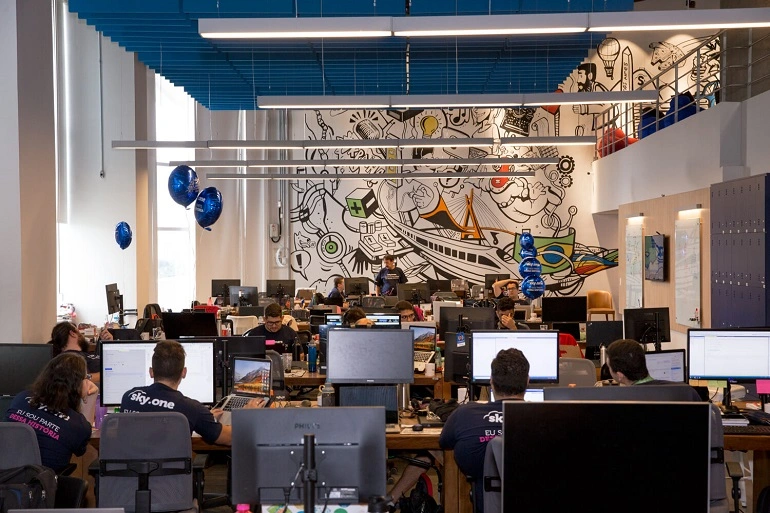

Systems integration is responsible for accelerating the results of more than 50 companies, according to data from Sky.One
According to Gartner's 2023 Technology and CIO Executive Agenda, among the actions that can be taken to accelerate the impact of investments in digital technology are prioritizing digital initiatives with the greatest potential impact on company finances, embracing the strengths of democratized access to technology, experience, and data, and creating a results-oriented metrics initiative. This is increasingly a priority for C-level executives. Evidence of this is the result of a July 2022 survey of 226 CFOs conducted by Gartner, which found that digital acceleration was the top spending priority for CFOs in the next 12 months, with 98% of respondents saying they would protect digital investments and, of these, 66% stating they plan to increase their investments in the category.
It's no secret that technology has been key to solving business challenges, and increasingly, the demand is for simple solutions that can be used by the entire team, without requiring extensive technical knowledge. This is the belief of Robson Del Fiol, Head of Sales and Marketing at the Integra.Sky of Sky.One . "The speed of innovation is a crucial factor for the success of companies in today's market. To use technology in this process, the learning curve of this new technology cannot be a barrier," he explains.
Del Fiol further comments that many companies have sought to address their business challenges through systems integration. "Before adopting new systems, it's necessary to leverage the maximum potential of the tools already implemented. That's why intelligent software integration has been an interesting solution," he says.
According to the expert, the service sector stands out and occupies first place in the search for systems integration. "Next come the industries and finally the more traditional retail, but this year we also had a boom of startups seeking us out to solve their ERP integration problems," says Del Fiol.
Competitive advantages
According to Del Fiol, the faster utility applications are built, the greater the degree of business innovation and, consequently, the higher the revenue, since the market relates better to companies that facilitate experiences. And it is this demand that low-code are designed to meet.
Del Fiol explains that on a pre-formatted and prepared platform, the low-code allows the user to assemble their own structure through already available modules and intuitive drag-and-drop processes, which enable the creation of integrations even by people with little technical knowledge, since they do not require complex coding. " Low-code , such as Integra.Sky, also help solve various corporate challenges, from the lack of specialized labor to the replicability and scalability of system integrations," he emphasizes.
Already aware of these benefits, companies have placed application and integration strategies among their top three technology priorities for 2022, according to Gartner's "Technology Adoption Roadmap for Midsize Enterprises." Furthermore, among the 53 technologies adopted in the area of infrastructure and computing platform services over the next three years is iPaaS (Integration Platform as a Service).
According to Del Fiol, by investing in these technologies, companies seek to boost IT and business hyperautomation, while improving speed and agility. “A platform (iPaaS) also allows users to develop their integration flows connecting to different applications, as well as organize, standardize, and scale these integrations with on-premises or cloud and external solutions, generating secure and highly replicable connections. It is also possible to expose your modules and integrations in the marketplace and make them available to any user of the platform,” he emphasizes.
Integrate to grow
Ensuring that software, applications, and resources work in an integrated way has allowed clients to meet their business needs. One example is Tijuca Alimentos, which integrated its Totvs Protheus ERP system with its internal management software using Integra.Sky. The company, the largest egg producer in the state of Ceará, benefited from reduced complexity in new processes, the ability to identify potential problems or errors before they reach customers, and the constant availability and real-time updating of data, leading to increased productivity and accuracy, avoiding rework and long waits for file updates. It also gained a more precise view of its business with its integrated software. Created in 2019, Integra.Sky emerged as a solution to the demands of Sky.One's cloud clients, who sought to integrate their ERPs with digital platforms. The goal was to reduce the problems of inconsistencies in manual processes and expenses related to inefficient integrations, contributing to more accurate decision-making and ease of execution.
To solve the problem, Sky.One developed an iPaaS that uses a low-code , aiming to democratize integration development and reduce the learning curve, which is precisely the key point of the low-code . “ Low-code is increasingly being adopted by companies to facilitate processes without needing internal developers. The main objective of Integra.Sky, therefore, is to standardize and scale integrations of legacy systems and external solutions, generating secure and replicable connections. In other words, it facilitates access to various software, creating the ideal environment to increase the performance of companies' internal teams,” he emphasizes.
Among the main differentiators of the solution, besides the possibility of performing secure and fast integrations, are the fact that the product applies to practically any system integration scenario and does not require advanced programming knowledge. It is worth highlighting that Integra.Sky also addresses three important pillars: compliance with LGPD , audit logs of all executions, and hybrid integrations, i.e., where the client has both on-premises and cloud-based systems.
Accelerated business
Since 2020, Sky.One has been investing in its Integra.Sky division to bring systems integration to more and more companies. Among its actions, the company has tripled its development team, with a dedicated sales team and an expanded services team, in addition to investing in new functionalities for integrations in hybrid scenarios.
Thus, Integra.Sky gained even more strength to help companies apply best practices in terms of scalability and high availability of cloud environments for integrations built across diverse customer segments. Integra.Sky's clients include Tijuca Alimentos, Thompson, Systax, Cashu, Comporte, and Ploomes.
Furthermore, Sky.One has established partnerships with SaaS companies that allow for the expansion of integration possibilities offered to clients, making the platform even more strategic for businesses. Now, Integra.Sky clients can easily and quickly integrate their systems with solutions such as VTEX, SAP, Protheus, Ploomes, Shopify, RD Station, and Zoho.
According to Del Fiol, this year the company was able to consolidate its investments in features that the enterprise values. “With a user-friendly interface, in addition to more partners in our ecosystem, we are focusing on consolidating our operations in each region. We already have clients in Panama, Colombia, the United States, and several Brazilian states, and there is a pipeline of new opportunities. Next year, we will invest even more in our sales reach, especially in the agribusiness, industry, service, and retail segments, which are still very much in need of good low-code ,” he states.
Sky.One is a multi-platform company and, with Integra.Sky, alongside Cloud, Cybersecurity, and Techfin, seeks to offer technological solutions to meet the ever-increasing needs of the market. By facilitating processes and supporting even companies with limited internal support, the expectation is that the Integra.Sky division will account for a quarter of Sky.One's revenue by 2024.


Start transforming your company
Test the platform or schedule a conversation with our experts to understand how Skyone can accelerate your digital strategy.