



For your team


Migrate to Skyone


Featured products


Ecosystem and collaboration









Databases: what they are, the main types, and how they work
Welcome to the essential world of data, the beating heart of almost all digital operations. In an era where information is as valuable as currency, understanding what databases , the different types that exist, and how they operate is crucial for anyone who wants to efficiently manage a business.
And it's no wonder: the volume of data produced worldwide is constantly growing: according to the World Economic Forum , experts indicate that by 2025, more than 463 exabytes of data will be created every day, the equivalent of approximately 212,765,957 DVDs .
Thus, in this article, we will unravel the concept of a database, an organized storage structure that not only keeps information secure but also makes it accessible and manageable .
Furthermore, we will explore the main existing types, how they benefit from cloud computing , and what challenges this technology presents for the future.
Enjoy your reading!
What is a database?
A database is a structured and organized collection of data that allows for the efficient management, storage, and retrieval of that information. Essential in digital environments, databases are crucial for the operation of a variety of systems, from business applications to social networks, for example.

What is the history of the evolution of databases?
This fascinating story dates back to the earliest information storage systems, which were manual and paper-based . With the invention of computers, the need arose to manage large volumes of data efficiently, leading to the development of the first database management systems (DBMS) in the 1960s.
Thus, these systems, such as IBM's IMS, were hierarchical or network-based and allowed companies to store and retrieve data more quickly and reliably than traditional methods.
Later, in the 1970s, researcher Edgar F. Codd introduced the relational model for databases , which revolutionized the way data was stored and accessed. The relational model allowed data to be organized into tables with rows and columns, where each table could be related to another through foreign keys.
This simplified database design and made queries more intuitive and powerful with the introduction of the SQL (Structured Query Language) . Relational database systems, such as Oracle, Microsoft SQL Server, and MySQL, became widely adopted in the following decades.
NoSQL databases in the late 2000s, which were designed to handle large volumes of distributed data and to offer more flexible schemas.
These databases, such as Cassandra, MongoDB, and Couchbase, are optimized for fast read and write operations and are capable of handling structured , semi-structured , and unstructured .
Currently, we are in the era of cloud databases and database-as-a-service (DBaaS) services, where cloud providers offer the infrastructure, maintenance, and scalability needed for management, allowing organizations to focus more on developing their applications than on managing the database.
Platforms such as Amazon Web Services (AWS), Google Cloud Platform, and Microsoft Azure provide a variety of services that support both relational and NoSQL models, offering high availability, durability, and data security.
Furthermore, artificial intelligence and machine learning are being integrated into modern database systems, enabling predictive analytics and real-time insights
Data vs. information: what's the difference?

Data represents raw , unprocessed that, by themselves, may not convey a clear meaning. For example, an isolated sequence of numbers, terms, measurements, or observations that, in isolation, do not provide understanding or context. They are the raw material that, after being properly processed and interpreted, transforms into information.
Thus, when organized and interpreted within a context, this data transforms into valuable information, gaining purpose and supporting decision-making, problem-solving, or serving as a basis for discussions and learning. In databases, this transformation is carried out through operations such as queries and reports, conducted by a DBMS (Database Management System).
What are the main types of databases that exist?
Exploring the main types of databases is essential to understanding how information can be managed and accessed. Each model is designed to meet different needs and uses distinct technologies. Check them out below:
Relational database management systems (RDBMS)
Relational databases use the SQL to manipulate and query data stored in tables with predefined relationships between them. They are known for their very high reliability and ease of data storage and retrieval.
NoSQL databases
NoSQL databases more flexible architecture , supporting a wider variety of data formats. Therefore, they are often chosen to handle large volumes of data that don't fit well into rigid tabular models.
Hierarchical databases
Hierarchical databases organize data in a tree structure , where each record has a single parent record. Their predefined structure is effective for data that follows a logical hierarchy, but they have limitations in complexity and flexibility.
Multimedia databases
As the name suggests, these databases specialize in storing and managing various media, such as images, audio, and video . Multimedia databases have specific technologies for the efficient indexing and retrieval of these types of data, which often require large storage capacities.
Object databases
This category stores information in the form of objects, similar to object-oriented programming languages. They are ideal for complex applications where data and their relationships can be represented more naturally as objects.
In- memory database
They are designed to reside in the computer's RAM , not on hard drives, which allows for extremely fast read and write speeds. They are an excellent option for systems that require real-time responses or have high performance demands.
What are the most commonly used databases today?
The database market is diverse, with various options tailored to the needs of information storage and retrieval. Currently, some stand out in use due to their functionality, performance, and reliability. These include:
MySQL
MySQL is a widely adopted relational database system due to its open-source nature and flexibility . Frequently used in web applications, it is known for its ease of use and good performance across different platforms.
PostgreSQL
PostgreSQL is a relational database with an emphasis on extensibility and SQL compliance. Useful for handling large datasets and complex applications, it is recognized for its robustness and advanced features.
Microsoft SQL Server
Microsoft SQL Server stands out in the business world for its integration with other Microsoft products. Primarily designed for Windows environments, it is chosen for its security and scalability.
Oracle Database
Oracle Database is a relational database solution developed by Oracle Corporation. It is a common choice for large enterprises due to its strong performance , ability to handle large volumes of data, and extensive transaction support.
MongoDB
document- oriented NoSQL database designed for ease of development and scalability. Its flexible storage structure is ideal for handling varied and massive amounts of data.
Redis
Redis is an in- memory used as a database, cache, and message broker. It is highly performant, with key-value data structures and support for atomized operations.
How do different market sectors benefit from a database?
Various market sectors gain competitive advantages through the efficient use of a database. In the retail , it optimizes inventory management and personalizes the customer experience. In the healthcare , they are essential for maintaining patient records and managing critical treatment and medication information.
Financial sectors rely heavily on databases for risk analysis, fraud prevention, and secure market operations. One example is Dados de Mercado , an open investment database that facilitates access to financial market information.
education sector , databases store student records, assessments, and educational content, encouraging personalized learning. Technology , handle massive volumes of data, making database systems essential for daily operations, security, and innovation in products and services.
For every sector, databases open up opportunities to improve processes , offer better services , and gain insights for strategic development. Therefore, specialized professionals are essential in this context.
Cloud vs. data center: which is the best option?
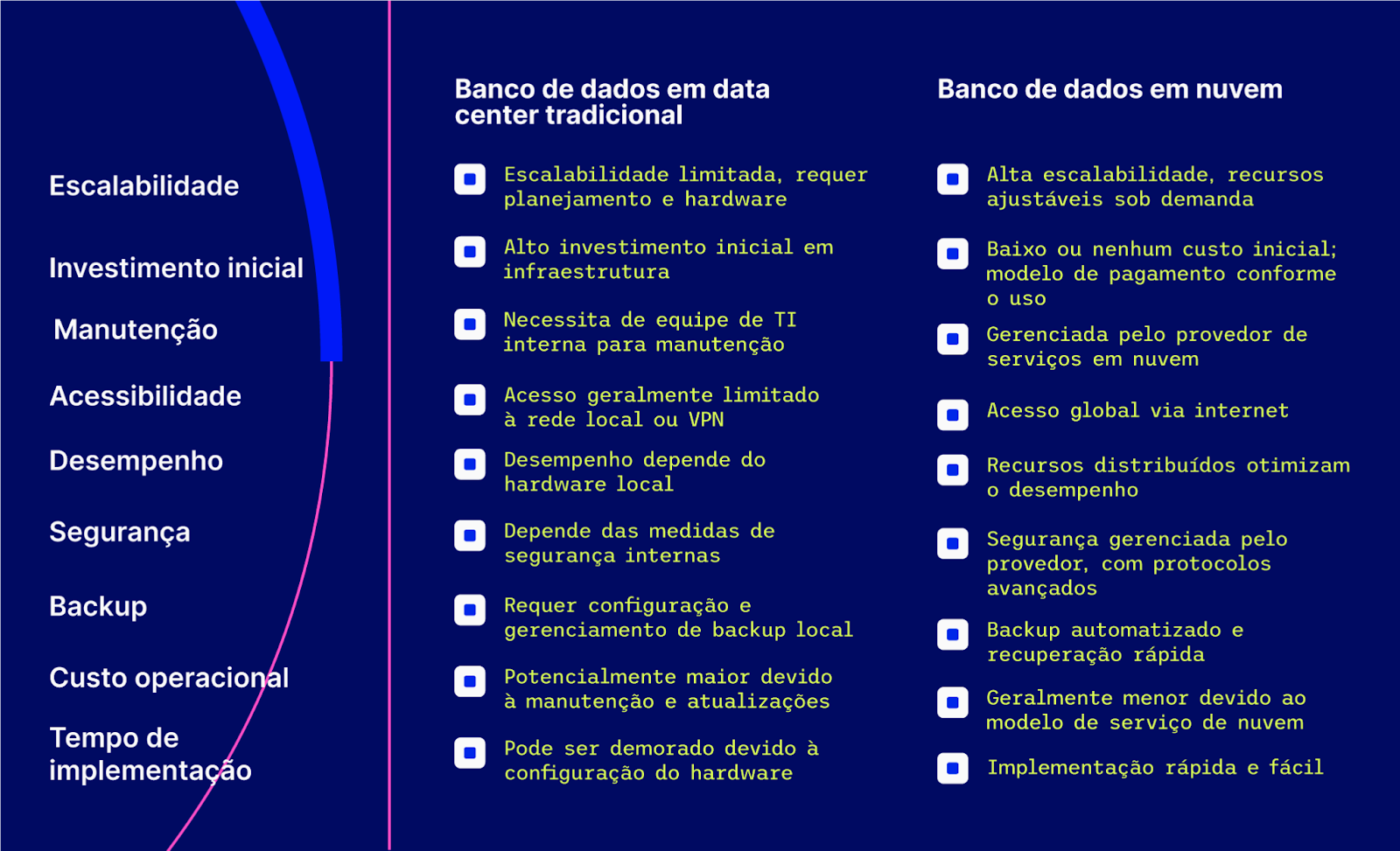
When companies consider IT infrastructure, they often face a choice between data centers and cloud computing. Both solutions have their merits and particular considerations, depending on the technological demands of each organization.
However, opting for a cloud database offers several advantages , mainly in terms of scalability, performance, and cost. With the cloud, companies can benefit from the ability to dynamically scale resources, paying only for what they use.
This means that as the demand for data storage or computing power increases, the bank can expand without the need for heavy investments in hardware . Furthermore, maintenance and updates are managed by the cloud service provider, reducing the workload of internal IT teams and minimizing downtime.
Another significant benefit is enhanced accessibility and collaboration. Data stored in the cloud can be accessed from anywhere in the world, as long as there is an internet connection. This facilitates remote work and collaboration between geographically distributed teams.
Security is also enhanced, as cloud service providers implement robust security protocols to protect data. Furthermore, in the event of disasters or hardware backup systems tend to be more effective, ensuring business continuity with less risk of data loss.
What are the main advantages of using a cloud database?
As we have seen, the use of cloud databases is becoming a trend, and the advantages reflect the potential of cloud computing to optimize data storage and manipulation in an efficient and secure way. See each of these advantages in detail below:
Scalability
Cloud databases offer easy scalability, allowing be increased or decreased as needed. This provides a more precise adjustment to the demand for storage and processing capacity.
Accessibility
Data accessibility is significantly improved with cloud-based databases, as they can be accessed from anywhere , at any time, as long as there is an internet connection.
Simplified management
Managing a database in the cloud is simplified because the cloud provider takes care of routine administrative tasks, freeing up the IT team to focus on higher-value activities.
Cost reduction
Cost reduction is a notable advantage, as it eliminates investment in hardware and physical infrastructure, in addition to minimizing maintenance expenses.
Advanced security
With a cloud-based database, security is enhanced through advanced data protection and compliance measures, which are constantly updated by service providers.
Automatic updates
Automatic updates ensure that the database is always using the latest available technology, without significant interruptions for the user.
Disaster recovery
In the event of failures or disasters, cloud-based distributed databases have robust recovery , reducing risks and downtime.
Continuous innovation
Continuous innovation is ensured, as cloud providers constantly invest in new technologies, allowing users to quickly benefit from improvements and new developments in the sector.
How does migrating a database to the cloud work?
Migrating a database to the cloud is a carefully structured process involving several steps. From planning to data transfer and monitoring, each phase is crucial to ensuring an effective and secure transition.
See each one of them:
Planning
In the planning phase, the distributed database to be used and the scope , analyzing the specifics of existing workflows. This is where the main objectives of cloud computing are identified, such as simplified management and scalability.
Backup and preparation
Before initiating cloud migration robust database is performed
Cloud resource provisioning
the resources are provisioned in the cloud . Future demand is taken into account to enable database scalability.
Data transfer
Data transfer must be performed using specialized , ensuring the integrity and security of information throughout the process.
Tests
After the migration, a series of tests are performed to ensure that the database in the cloud is functioning as expected , without data loss or interruptions to workflows.
Application update
Adjusting the applications involved is necessary for them to communicate correctly with the new distributed database environment in cloud computing .
Monitoring and optimization
With the database already operating in the cloud, continuous monitoring is essential to detect any problems. Optimization is an ongoing process to improve performance and efficiency.
Continuous backup
It is vital to maintain a routine of continuous database backups after migration, ensuring that information is secure and can be recovered in case of failures.
The main challenges and trends in databases
Big data
The key aspects here are managing massive volumes of data, the speed required to process and analyze this data in real time, and the variety of data types that need to be integrated, from structured to unstructured data.
trends in big data focus on the adoption of technologies such as Hadoop and Spark for distributed processing, as well as the use of NoSQL database management systems to handle the variety and agility of data.
Furthermore, there is a growing movement towards data-as-a-service (DaaS) platforms and artificial intelligence to improve analytical capabilities and automate data processing.
Machine learning
In the field of Machine Learning applied to databases, the challenge is to develop models that can not only handle large volumes of data, but also learn and adapt efficiently and accurately. This involves issues of scalability, training time, and the ability to handle noisy or incomplete data.
Trends point towards deeper integration of machine learning capabilities directly into database management systems, enabling predictive analytics and data-driven decisions to be made in near real-time.
The use of AutoML for automating machine learning processes and the exploration of deep learning for insights are also on the rise.
Security and privacy
The challenges in security and privacy are amplified by the growing amount of sensitive data and stringent regulations such as the LGPD (Brazilian General Data Protection Law). Protection against unauthorized access, cyberattacks, and data breaches are constant concerns.
Trends in this area include the implementation of advanced encryption techniques, such as homomorphic encryption , which allows operations on encrypted data without the need to decrypt it. Furthermore, there is a growing focus on privacy solutions that allow the use of data for analysis without compromising the identity of individuals, such as anonymization and the use of differential privacy techniques.
Another trend is the development of more robust access and identity management systems, which use multifactor authentication and least privilege management to enhance security. Artificial intelligence is also being applied to detect abnormal usage patterns and potential threats in real time, improving the ability to respond to security incidents.
Your database in the cloud with Skyone
When considering migrating your database to the cloud, it's essential to choose a partner that not only understands the complexities of this transition, but also offers robust solutions and dedicated support .
That's why Skyone stands out as the ideal partner for companies seeking to perform this migration safely and efficiently. With a team of highly qualified , we promote a smooth transition from your on-premises database to cloud solutions, ensuring that data integrity, security, and performance are maintained or even improved.
Find out how we can help your business!
Conclusion
There is no doubt: in the digital age, the ability to access and analyze information quickly is a competitive advantage . Therefore, databases support this need with features that include immediate access, backup, robust recovery, and much more.
The technologies involved in database systems have evolved significantly, and cloud computing has made this tool even more powerful for businesses that want to grow and stand out in the market.
Continue your learning journey by checking out our complete guide to cloud migration!

Start transforming your company
Test the platform or schedule a conversation with our experts to understand how Skyone can accelerate your digital strategy.