



For your team


Migrate to Skyone


Featured products


Ecosystem and collaboration








What is generative AI, how does it work, concepts and applications?
Generative AI is transforming the world of technology. In simple terms, it's a form of artificial intelligence capable of creating new content such as text, images, music, and videos from existing data.
Unlike other types of AI that only analyze and classify information, generative AI learns complex patterns and replicates them creatively, offering new and surprising solutions.
Follow along to the end and enjoy reading!
Generative AI is a subfield of artificial intelligence focused on creating new data. Unlike analytical AI, which organizes and studies information, generative AI creates original content, often indistinguishable from that produced by humans.
Its main principles include:
- Artificial neural networks , inspired by the workings of the human brain.
- Generative modelssuch as:
- GANs (Generative Adversarial Networks)
- VAEs (Variational Autoencoders)
- LLMs (Large-Scale Language Models)
- Diffusion Models (widely used in image generation)
- GANs (Generative Adversarial Networks)
These models learn from existing data and generate new, realistic content, continuously adjusting their results.
Read also: What are LLMs and how to apply them to your business with your own data?
The origins of generative AI date back to the 1950s and 1960s, with algorithms based on logical rules. In the 1980s, advances in neural networks and the backpropagation brought new possibilities.
Already in the 2010s, with the strengthening of deep learning and the launch of GANs and VAEs, generative AI became a practical and accessible tool for various applications – from art to medical diagnoses.
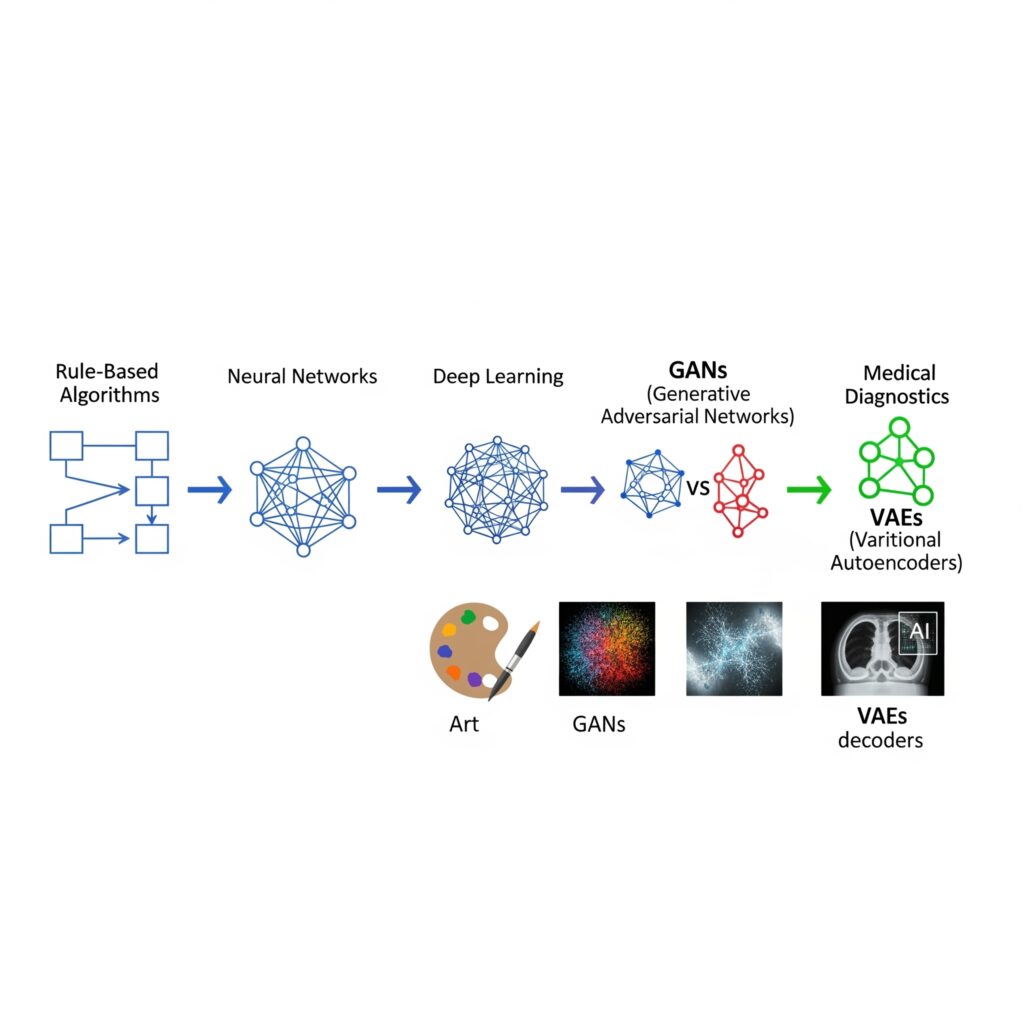
Generative AI uses complex deep learning algorithms to identify patterns in data and generate new insights.
In models like GANs, the process can be divided into two parts:
- Generator: creates new data
- Discriminator: evaluates whether the generated data is realistic.
This constant feedback mechanism allows for continuous improvement of the system.
Main technologies used:
- Convolutional and recurrent neural networks: interpret visual and sequential patterns.
- Supervised and unsupervised learning: enable adaptation to labeled and unorganized data.
- Transformers and attention mechanisms: used in language models to generate texts with contextual coherence.
To better understand, see a direct comparison between the two approaches:
| Feature | Traditional AI | Generative AI |
| Objective | Analyze, predict, and classify | Create new content |
| Data type | Structured and historical data | Textual, visual, and creative data |
| Applications | Diagnosis, demand forecasting | Creating images, text, and videos. |
| Approach | Analytical | Creative and adaptive |
Generative AI is already present in several sectors:

In healthcare , AI supports diagnoses, performs automated triage, and generates clinical reports more quickly. At the same time, the sector faces significant challenges, as many systems are not yet fully prepared to handle large volumes of sensitive data and automated workflows.
In entertainment , it enables the creation of music, films, scripts, and visual effects. In the design and fashion , it assists in prototyping and developing AI-assisted creations.
In marketing , it allows for personalized campaigns and the production of content at scale, while in education it enables adaptive teaching materials and virtual tutors that enhance the learning experience.
It also democratizes the creation of content in different formats:
- Texts: articles, summaries, captions, scripts
- Images: illustrations, thumbnails, visual campaigns
- Audio: soundtracks, voiceovers, effects
- Videos: animations, automatic cuts, clips
Generative AI offers benefits that go beyond traditional automation:
- Creative automation: generates original content and optimizes teamwork.
- Cost reduction: manual tasks can be performed quickly by trained algorithms.
- Innovation at scale: allows you to experiment with new ideas at low cost.
- Personalization: adapts communications, products, and services to each user's profile, increasing engagement.
Despite its vast potential, generative AI algorithmic bias and lack of transparency stand out , which can lead to distorted or unfair results.
There is also the possibility of malicious use , such as the creation of deepfakes and the dissemination of disinformation, which represent serious threats to the integrity of information and public trust. Furthermore, generative AI is known for its high energy consumption , raising environmental and sustainability concerns. Finally, ethical and intellectual property issues , especially regarding authorship and the use of data for training.
According to material produced by HubSpot , generative AI is still in its early stages and "wasn't made to do everything." The most critical point is its dependence on data quality : models trained with incomplete or biased information tend to reproduce errors in the generated content. Therefore, the role of human creators remains essential – AI should be seen as a support tool, not a complete replacement. This dependence on data naturally leads to the next point: the importance of technologies and innovations that organize and enhance the use of this information.
The advancement of generative AI only becomes fully realized when there is a solid database, system integration, and an environment prepared for automation. This is precisely where Skyone Studio .
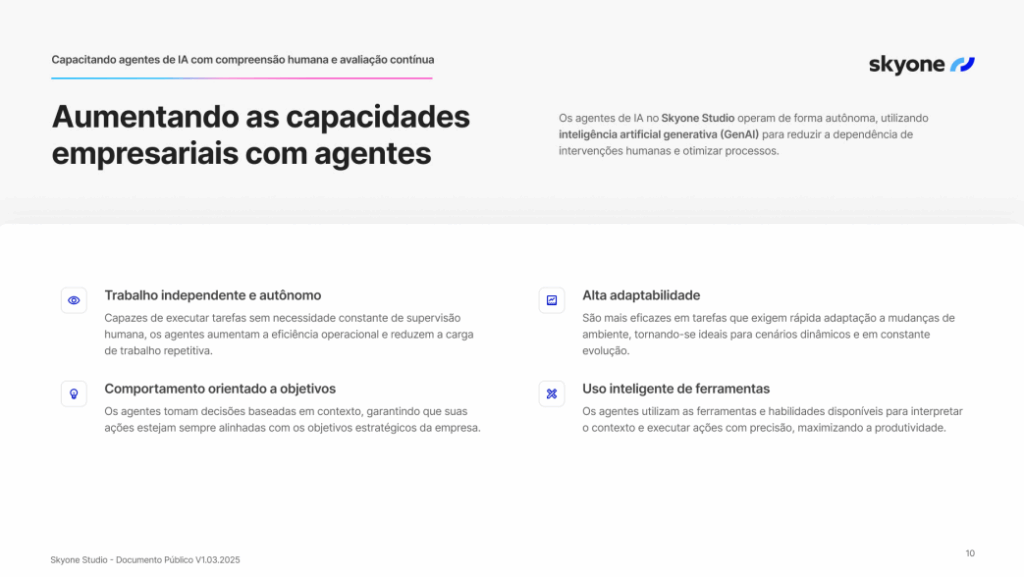
More than just a solution, Skyone Studio is a product that connects data, integration, and artificial intelligence in one place. It organizes company information, automates workflows, and powers AI agents with GenAI (Generative Artificial Intelligence) capable of operating on channels like WhatsApp, optimizing sales, customer service, and operations.
Key features of Skyone Studio:
- Automated data collection, reducing manual work
- Reports with insights delivered directly to internal systems or messaging channels
- Publishing AI flows on interfaces like Google Chat or WhatsApp
- Connectors ready for over 400 systems (SAP B1, Zoho, HubSpot, among others)
- Low-code resources and specialized technical support.
With a robust and secure structure, Skyone Studio helps companies create and scale applications with generative AI, transforming data into real intelligence integrated into day-to-day business operations.
Conclusion
Generative AI is no longer a promise, it's a reality. It is transforming the way we create, innovate, and interact with technology.
If you are looking to implement GenAI in your company, sector, or institution, start now:
- Assess your infrastructure
- Map out risks and opportunities
- Empower your team
- Seek out reliable partners
Want to know how to apply generative AI safely and with real results?
Talk to a Skyone expert and learn about our AI and data projects.

Start transforming your company
Test the platform or schedule a conversation with our experts to understand how Skyone can accelerate your digital strategy.