



For your team


Migrate to Skyone


Featured products


Ecosystem and collaboration









Cloud migration: everything you need to know
In the digital age, cloud migration has emerged as an essential topic for business success.
As the demand for agility and efficiency grows exponentially in the market, the adoption of cloud solutions has become imperative to drive digital transformation .
According to data from the Annual Survey of the Center for Applied Information Technology of the Getúlio Vargas Foundation (FGVcia) , cloud computing already represents, on average, 42 % of processing in companies in Brazil.
And it's no wonder: the cloud offers a world of possibilities for adjusting resources as business demands evolve, allowing for quick responses to market changes, cost reduction, and other benefits.
Want to know everything about how migrating to the cloud can boost your business?
In this special feature, we'll delve into the nuances of technology, exploring the options , benefits , and challenges this transition offers businesses. Get ready to uncover the secrets of the greatest strategic path to technological excellence!
What is cloud migration?
Cloud migration refers to the process of transferring data, software, and services from an on- premise remote servers and computing resources hosted on the internet, known as the "cloud."
Thus, the cloud enables the remote use, via the internet, of various computing resources. A company's programs and applications can be accessed anytime, anywhere by authorized individuals.
In practice, this reduces the company's spending on physical equipment such as computers, servers, and air conditioners. According to Gartner , cloud computing is 40 times more economical compared to companies' internal IT infrastructures.
Furthermore, it generates savings in terms of physical space itself, as it is no longer necessary to house a data center, for example.
The 7 Rs, or types of cloud migration
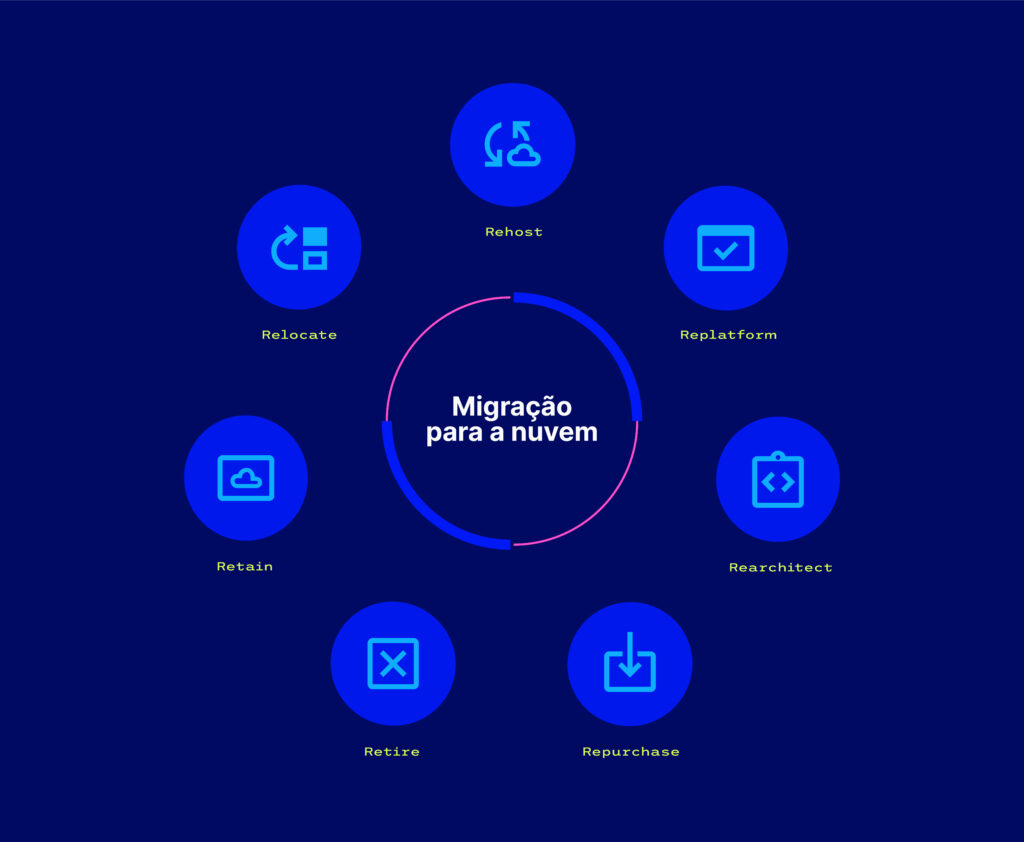
There are numerous cloud migration strategies, and the right choice will depend on your company's specific needs application architecture , and long-term goals .
Better known as "the 7 Rs of cloud migration ," here are some of the main existing strategies, which can be used alone or in combination:
1. Rehost
More commonly known as " lift and shift ," this is a strategy that migrates existing applications to the cloud without modifying their code . Therefore, it's a fast approach, but it may not fully leverage the native benefits of the cloud.
2. Replatform
Also called " lift and improve ," it performs some optimizations on applications before migration, taking advantage of native cloud resources. This may involve updating operating systems, databases, or other components.
3. Rearchitect
It's a strategy that completely restructures applications to make them cloud-native. It allows you to take full advantage of technology, such as microservices architecture and containers.
4. Repurchase
A " drop and shop " strategy that replaces on-premise Software as a Service (SaaS) solutions available in the cloud.
5. Remove
When it is necessary to disable and remove applications or components that are no longer needed during migration.
6. Retain
When it is necessary to maintain applications or data in local infrastructure or in specific environments, without migrating them to the cloud.
7. Relocate
Like "rehosting," it also involves moving existing resources to the cloud, but the term is more often associated with the physical transfer of infrastructure from one location to another, including the relocation of servers and hardware.
What types of clouds exist?
Regarding the nature of the deployment , there are three main types of cloud storage that meet the different needs of organizations. Check them out below:
Public cloud
The public cloud is a computing infrastructure offered by specialized providers , outside of a company's IT environment. In this model, resources such as servers, storage, and services are shared and accessed via the internet .
Companies can use these resources flexibly , scaling them according to their operational needs, without having to invest in their own infrastructure. Therefore, the public cloud stands out as an agile, efficient, and cost-effective for organizations of all sizes.
Example: AWS (Amazon Web Services) , Microsoft Azure , Google Cloud Platform
Private cloud
On the other hand, a private cloud , in practice, is a cloud computing model in which IT resources are dedicated exclusively to a single organization .
Unlike the public cloud, services and data in a private cloud are generally maintained in an environment controlled internally by the organization or by a third-party provider. Therefore, the private cloud is better suited for companies with stringent security and regulatory requirements, providing operational flexibility and agility.
Example: Customized implementations in private data centers.
Hybrid cloud
Finally, the hybrid cloud is an approach that combines public and private cloud environments, allowing organizations to integrate and manage their data and applications flexibly. This modality enables the movement of workloads between cloud environments as needed, optimizing performance, security, and operational efficiency .
Companies can use the public cloud for instant scalability and innovation, while keeping sensitive data and critical applications in a private cloud infrastructure, providing a versatile solution adaptable to the specific needs of each organization.
Example: Using local resources and public cloud services simultaneously.
How do cloud computing services work?
Today, there are three main types of cloud services, each offering different levels of control, management, and functionality.
These types are often called service models , that is, models that define how resources are made available to users. Check it out:
Infrastructure as a Service (IaaS)
It provides a virtualized where users can provision resources, such as virtual machines and storage, without the need to invest in physical hardware.
Platform as a Service (PaaS)
It offers a complete platform, including hardware, operating system, and development tools, so developers can create and deploy applications without managing the infrastructure.
Software as a Service (SaaS)
ready-to-use applications for the internet, eliminating the need for local installation and maintenance.
How does the cloud migration process work?
When deciding to migrate your company's software or data to the cloud, the next step is to develop a careful plan that minimizes disruptions, manages security risks, and optimizes resources and costs.
In this way, the transition occurs efficiently and without setbacks. Check out the main steps of the process below:
Planning
Before the actual migration, it's necessary to understand which applications and data will be moved to the cloud and what your business needs are.
Therefore, a thorough analysis of requirements, costs, and benefits should be conducted, including identifying dependencies between systems and defining specific goals.
Choosing a provider
At this stage, it's time to select a cloud provider that suits your company's needs. Each provider offers a range of services, such as storage, computing, and databases .
Therefore, the IT team is trained to work with the specific technologies and tools of the chosen cloud. This step is essential to ensure efficient management after migration.
Migration
Finally, the data and applications are transferred to the cloud. This may involve replicating databases, recreating application environments, and setting up networks in the cloud.
In some cases, migration is done in stages , allowing specific parts of the infrastructure to be transferred gradually.
Training
After the migration is complete, the team needs to know how to operate in the new environment.
Therefore, it is important to provide training for employees on daily management, problem-solving, and optimization.
Maintenance and improvements
Just like technology as a whole, the cloud is also constantly evolving . Therefore, companies need to stay up-to-date with best practices, security updates, and new features offered by their cloud provider.
It's an ongoing process!
How do I know when it's the right time to migrate my company to the cloud?
The decision to migrate a company's data and operations to the cloud needs to be strategic and carefully considered.
cost- benefit and risk analysis can help determine the right time for migration – ensuring that the transition is aligned with your company's specific goals and needs.
However, there are some immediate indicators that may signal that the business needs a cloud environment as soon as possible . These include:
Need to scale
If your company faces challenges scaling IT resources as demand grows, the cloud offers the necessary flexibility.
High operating costs
Costs related to maintaining local infrastructure often weigh heavily on companies' budgets. In this sense, the cloud is a more economical alternative , especially with the pay-per-use model.
Adoption/upgrading of technologies
Over time, local infrastructures are becoming obsolete and requiring significant investments in upgrades. Now is the time to migrate to the cloud and gain greater cost-effectiveness and efficiency.
Optimizing remote work
With the COVID-19 pandemic and the redefinition of work models, companies need remote access for home office work . Thus, migrating to the cloud enables greater collaboration, with data sharing accessible from anywhere.
Safety and compliance
Today, most companies handle some type of sensitive data, needing to meet stringent security . Therefore, a private or hybrid cloud solution is the most suitable – and also ensures compliance with the law.
Growth in data volume
Currently, the amount of data stored and processed in companies is increasing significantly . Therefore, adopting a cloud strategy offers not only scalability but also security for managing large volumes of data.
Overburdened IT team
If your IT team is overwhelmed by the complexities of managing on-premises infrastructure, the cloud can simplify administration and allow the team to focus on what matters – the business.
What are the benefits of migrating to the cloud?
Cloud computing is a key enabler for innovation , allowing for the rapid adoption of new technologies such as artificial intelligence and machine learning .
In recent years, its presence has transformed the way companies operate, promoting agility, global collaboration, and business continuity in a dynamic digital environment.
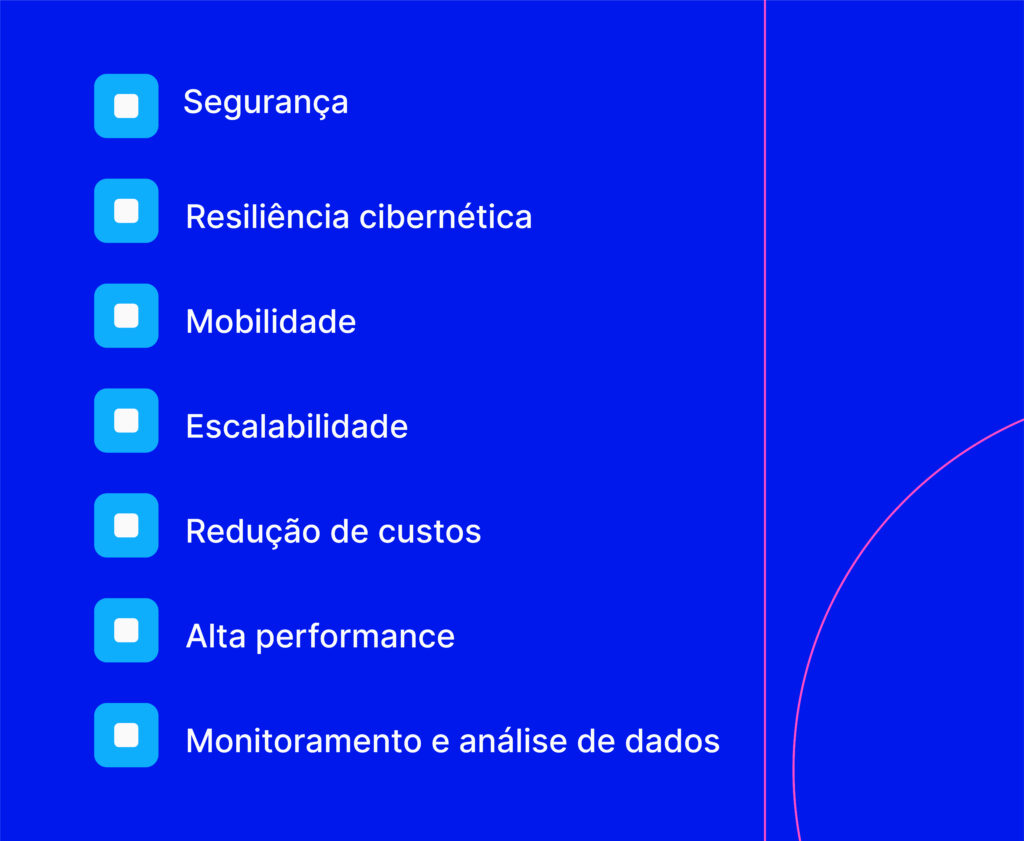
Thus, migrating to the cloud offers a number of benefits that positively impact operational efficiency and day-to-day business operations. Here are a few of them:
Security
Today, cloud migration offers data encryption for businesses, ensuring the security of crucial business information. Furthermore, firewall protection barriers are highly advanced, making the cloud one of the most secure places in the corporate world.
Furthermore, many platforms have a unique on the market, also securely and automatically deploying the infrastructure to the cloud.
Another point is that businesses now have access to 24/7 cybersecurity and privacy management by cloud specialists, which further contributes to compliance with security best practices and threat neutralization.
Cyber resilience
The cloud offers robust disaster recovery capabilities, enabling businesses to quickly restore systems and data in the event of failures. This contributes to business resilience and continuity, minimizing the impact of adverse events.
Furthermore, with automatic cloud backup, critical data is regularly copied and securely stored. This reduces the risk of data loss due to technical failures, human error, cyberattacks, or natural disasters, providing an additional layer of protection.
Mobility
Once all the information is entered into the system, it can be accessed from anywhere, at any time, by registered users. The team, even working remotely, can collaborate in a more integrated way , accessing the same documents and updating them in real time.
Furthermore, the cloud facilitates the integration of mobile devices , offering a consistent experience across different platforms, boosting operational agility and adaptation to the dynamic demands of today's business environment.
Scalability
The cloud adapts to the company's needs , meaning it's possible to acquire more storage space for a specific period of time. This way, the business doesn't need to expand its capacity to meet temporary demands or experience downtime that would frustrate customers.
In this sense, the company can predict how much it will spend on IT – and this helps the finance team, since these are "unpredictable" expenses when the software is local.
Cost reduction
Perhaps the advantage that most appeals to business owners regarding the cloud is the reduction in costs .
Paying only for the resources used can make a big difference in expenses, eliminating costs for hardware, new equipment, software licenses, energy, and more.
High performance
Cloud computing promotes operational efficiency through process automation , automatic updates , and the ability to rapidly implement new features and services.
In this way, the delivery of managed services in the cloud frees up IT teams to focus on strategic initiatives , driving agility and innovation in the business.
Data monitoring and analysis
The cloud facilitates the implementation of data analytics solutions . Organizations can leverage advanced monitoring tools that provide real-time into the performance of applications, networks, and infrastructure.
These solutions offer detailed metrics , automatic alerts, and customizable dashboards, enabling a rapid response to events and proactive identification of potential problems.
How to migrate to the cloud securely?
Cloud migration is a delicate operation that involves transferring data, applications, and processes from an on-premises infrastructure to a cloud environment. To ensure this process is secure, it is crucial to follow security best practices .
Below are some key tips for securely migrating your company to the cloud:
Create a security map
Conduct a security assessment
Choose a reliable provider
Select reliable and established cloud providers with a proven reputation for security. Evaluate their security practices, certifications, and compliance with industry standards.
Use encryption
Use encryption to protect sensitive data during transfer and storage in the cloud. This adds a layer of security , even if a breach occurs.
Establish access control
Implement strict access controls to ensure that only authorized users are allowed to access cloud resources. Use federated identity and access management to ensure proper authentication.
Perform continuous monitoring
Establish continuous monitoring systems to detect suspicious or security breaches. Use security analytics tools and regularly monitor event logs.
Enable backup and disaster recovery
backup and disaster recovery strategies . This ensures data availability and integrity, even in the event of failures or incidents.
Keep everything updated
Keep all systems and applications updated with the latest security patches. This is crucial for mitigating known vulnerabilities.
Use the security features
Utilize security services offered by cloud providers, such as firewalls intrusion detection services key management solutions .
Train your team
Provide regular training on security practices for your IT team. User awareness
Perform security tests periodically
Conduct regular security tests and assessments, such as penetration tests, to identify and correct potential vulnerabilities.
The future of cloud migration
According to Deloitte , the market value of cloud computing could reach an incredible US$640 billion in the next five years. This means that this is a technology that will not stop evolving – and surprising us – anytime soon.
In the future, significant challenges will still exist – often related to security and data protection issues. However, new models that seek to offer the best solutions in the world will continue to break down barriers.
Below are three of the main trends for the future of cloud migration, according to Forbes :
AI as a Service
The cloud has a major role to play in the spread of AI , along with all the economic and social benefits it brings.
Today's AI models are trained on vast amounts of data, using enormous computing power. Most companies don't have the resources to do this on their own – but by accessing AI as a service through cloud platforms , they can leverage this powerful and transformative technology.
Multicloud
multicloud (i.e., purchasing cloud services from more than one provider) is expected 76% to 85% in the coming years.
Thus, multi-cloud and hybrid clouds are advanced infrastructure solutions that will continue to grow in popularity as organizations seek to balance security with flexibility.
Cloud-driven innovation
Beyond AI, cloud computing can be a gateway to many other transformative technologies , such as the Internet of Things (IoT), blockchain , and quantum computing.
By eliminating the need to invest directly in architecture and infrastructure, companies will be able to launch initiatives to assess the benefits of emerging technologies more easily than ever before.
Conclusion
In an increasingly dynamic and competitive landscape, migrating to the cloud is vitally important for driving digital transformation and ensuring your company's operational efficiency.
Now that you understand its importance, count on Skyone to unlock your company's full potential in the digital world.
Our platform offers complete cloud computing solutions, including Autosky efficiently and securely migrates you to the cloud in just a few hours . This transformation can result in IT cost savings of up to 70%!
Our team of experts takes care of everything to ensure your migration is successful – giving you the opportunity to focus on what matters most: your business.
Come and discover how we can propel your journey to cloud success!

Start transforming your company
Test the platform or schedule a conversation with our experts to understand how Skyone can accelerate your digital strategy.