



For your team


Migrate to Skyone


Featured products


Ecosystem and collaboration









What is iPaaS: understand how cloud-based integration platforms can transform your business
In today's business environment, the need for effective integration between systems and applications has become increasingly important. With market demand for ever more specialized technologies, the major challenge is ensuring that new software, applications, and resources function in an integrated manner, delivering complete information in real time.
Thus, iPaaS , or integration platform as a service, has emerged as a powerful solution to this challenge, enabling a simple and fast connection experience
Because it's a cloud-based that integrates a set of platforms and functions as a service, iPaaS has a much lower cost compared to the previous market trend, which was based on purchasing software licenses.
The success of this type of technology is resounding, and the numbers don't lie: a study by Reportlinker predicted that the iPaaS market value will reach US$13.9 billion by 2026 , registering a growth of 30% per year.
Therefore, throughout this article, we will explore what iPaaS and how this innovative technology is transforming the way companies approach systems integration in the cloud computing era.
Discover how iPaaS not only solves traditional interoperability challenges, but also becomes an essential enabler for continuous innovation and competitive advantage!
What is iPaaS?
iPaaS, or " Integration Platform as a Service cloud -based solution designed to facilitate the integration of different systems, applications, and data sources. It is a key technology for organizations seeking agility and efficiency in communication between their various digital tools.
Because it is scalable and flexible , iPaaS helps companies accelerate the digitization of business processes, reduce IT workload, and improve operational efficiency. Therefore, it is especially useful in scenarios where businesses use a mix of cloud and on-premises applications and need fast and reliable integration between them.
Using iPaaS allows you to overcome traditional integration barriers, reducing the complexity and cost of connections between diverse applications. This is because the platform offers a centralized environment where multiple integrations can be developed, managed, and monitored.
Thus, with its implementation, it is possible to increase the fluidity of business processes, facilitating the exchange of data in real time and improving strategic decision-making.
Furthermore, iPaaS adapts to technological changes and new market requirements. This is crucial in an era where new applications and devices are constantly emerging and need to be integrated quickly and securely.
How did iPaaS come about?
iPaaS began to gain prominence in the 2000s . With the rise of SaaS (Software as a Service), companies began to face increasing challenges in integrating dispersed cloud applications with on-premises and with each other.
The need for more agile, flexible, and scalable integration led to the development of integration platform as a service solutions, which enabled the connection and automation of business processes between different applications, regardless of where they were hosted.
Over time, iPaaS has evolved to offer not only application integration, but also advanced features such as business process orchestration, API management, data governance, and security. This evolution has been driven by the ongoing migration to the cloud, the increasing volume and variety of data, and the need for digital transformation in companies.
What is the difference between iPaaS and other integration solutions?
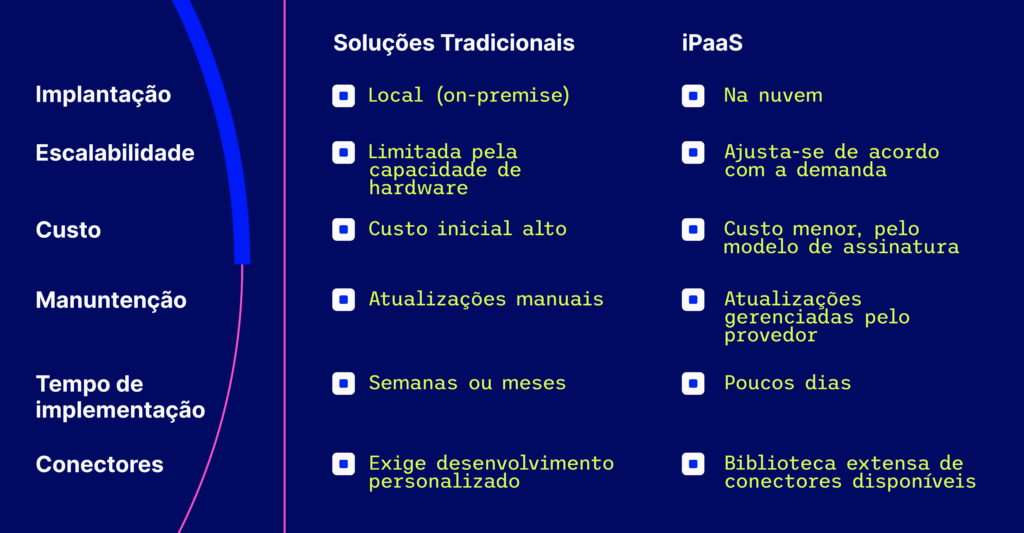
Unlike traditional integration solutions, which typically require local installation and hardware and software maintenance, iPaaS simplifies integration through a more agile and flexible .
With a subscription model, initial costs are reduced, and the platform allows for easy and rapid scalability, adapting to dynamic and variable business needs. Maintenance and updates are managed by the provider , relieving the operational burden on company IT teams.
Furthermore, traditional integration solutions (often built on on-premise ) require significant investments in hardware and software, as well as a dedicated team for maintenance and updates.
These solutions are less flexible and can be more difficult to scale, requiring additional effort and expense to handle growth or changes in business requirements.
While they can offer robustness and control, traditional integrations often result in a longer and more complex implementation process compared to iPaaS solutions, which promote rapid and efficient system integration with a more modern, cloud-oriented approach.
See below a comparison table between these two types of technology:
What is the difference between iPaaS, SaaS, PaaS, and IaaS?
When we talk about iPaaS, confusion often arises regarding this type of technology and other similar acronyms that are also trending, such as SaaS, IaaS, and PaaS . So, what exactly is the difference between them?
In practice, all these acronyms represent cloud computing services , and that's why they are similar to each other. But to execute different business processes, today there are many service offerings available.
Therefore, when a company finally makes the decision to opt for cloud services for the implementation and application of its infrastructure, it is essential that it understands the fundamental difference between these categories.
Now that we've seen what iPaaS , check out what the other acronyms mean below:
SaaS (Software as a Service)
It's a software distribution model where applications are hosted by a service provider and made available to users over the internet. In SaaS, the provider manages all the infrastructure, including servers, storage, and security.
Thus, it is used to provide ready-to-use software applications, which can range from email and collaboration to CRM (Customer Relationship Management) and ERP (Enterprise Resource Planning) tools.
PaaS (Platform as a Service)
development and deployment environment . Developers can create, run, and manage applications without worrying about the underlying infrastructure.
It is mainly used by developers who want to create applications without having to worry about servers, storage, updates, and maintenance.
IaaS (Infrastructure as a Service)
It is a cloud computing service model that offers computing resources on-premise data center , including servers, network hardware, storage, and the hypervisor or virtualizer.
It is frequently used by organizations that wish to avoid the cost and complexity of purchasing and managing their own physical servers and other data center infrastructure.
How does an iPaaS work in practice?
Now that you know what an iPaaS is and how it differs from other acronyms, it's necessary to understand how this concept applies in practice and in the day-to-day operations of businesses.
It is a vital technological solution for companies that need to synchronize and manage data and applications effectively. As a company grows, the complexity of its IT systems and the volume of data that needs to be processed increase exponentially.
In addition to being flexible enough to interconnect different systems and applications, this environment offers tools and resources to increase operational efficiency and improve data management within companies.
Below are some examples of how an iPaaS can be used in practice:
Pre-built connectors and adapters
A central element of iPaaS is its pre-built connectors and adapters Low-code platforms , which according to Gartner are expected to grow by 70% by 2025 , allow for quick and direct connection to a wide variety of applications and IT systems, substantially reducing the need for custom code development. This ready-made infrastructure is key to system scalability, as it can easily adapt to new platforms.
Orchestration of integration processes
Integration process orchestration occurs when iPaaS coordinates and automates complex integration tasks. This orchestration is crucial for operational efficiency, allowing companies to create workflows that execute without the need for manual intervention.
Centralized monitoring and management
Centralized monitoring and management simplify iPaaS administration. Through a single interface, it's possible to track the entire data flow , validate the performance of integrations, and quickly identify any issues requiring attention. This enhances the monitoring and management capabilities offered by iPaaS tools.
Safety and compliance
Security and compliance are fundamental aspects of any IT system, and the iPaaS environment is no different. The platform must ensure that all data is protected and that integrations comply with current regulations. iPaaS tools are responsible for maintaining high security standards and facilitating compliance with laws and guidelines.
iPaaS use cases
Adopting iPaaS platforms offers numerous possibilities for companies to modernize their operations, mainly through efficient system integration and process automation.
Thus, this technology emerges as a robust solution for connecting diverse applications in different environments, enabling optimized management of workflows and data. Below are some use cases where iPaaS can be applied:
Integrating legacy systems with modern platforms
iPaaS platforms play a crucial role in integrating legacy systems with new applications. They create a communication channel that allows older systems still in use to seamlessly interact with more advanced technologies, maintaining business continuity and adding new functionalities without the need to completely replace existing infrastructures.
Automation of complex workflows
In the automation of complex workflows, iPaaS platforms stand out for allowing repetitive tasks and multifaceted processes to be orchestrated with minimal human effort . This makes it possible to create rules and conditions that determine how and when tasks should be executed, significantly increasing operational efficiency.
Cloud and on-premise
iPaaS is ideal for hybrid integration , where cloud and on-premises need to be connected. This form of integration supports different environments, allowing organizations to take advantage of cloud scalability while maintaining certain applications locally, according to their security and compliance needs.
Examples of use in different market sectors
iPaaS platforms are used by companies in different sectors. In the HR onboarding processes are optimized . In marketing , data-rich campaign strategies become more agile. Other sectors, such as finance and healthcare , also benefit from the systems integration and process automation provided by iPaaS solutions, adapting their operations to the demands of the current market.
What are the main benefits of iPaaS for businesses?
Integration service platforms are emerging as a robust solution for companies seeking to optimize their processes. They offer a set of strategic benefits , contributing to automation, cost optimization, and improvements in efficiency and security.
Process automation
Companies that implement iPaaS benefit from process automation, which in turn reduces the need for manual tasks and enables more effective data management
This translates to faster task execution and fewer errors, allowing for real-time performance and immediate detection of patterns and trends.
Cost optimization
By minimizing reliance on multiple integration software solutions and the need for ongoing maintenance, iPaaS can lead to significant cost optimization.
Thus, the reduction in the complexity of systems integration and the savings on specialized technical personnel are tangible financial advantages for companies.
Productivity and scalability
With iPaaS, businesses not only gain in productivity, due to improved automation and efficiency, but also in scalability.
This is because iPaaS platforms are designed to support business growth , allowing for quick and flexible additions of new services and applications without impacting existing operations.
Fast and secure integration
As we mentioned earlier, fast and secure integration between different systems and applications is possible through iPaaS.
This technology allows connections to be established with guaranteed data security compliance standards and protecting corporate and customer information.
Improved customer experience
Companies use iPaaS to improve customer experience by integrating various data sources, providing a 360º view of the customer.
This allows for personalized service and a faster response to demands, resulting in a more efficient and effective service.
What should be considered during the implementation of an iPaaS?
When considering implementing an integration platform as a service, companies should carefully evaluate several key aspects that will affect the security, efficiency, and success of the integration. These include:
Data security and privacy
Security is paramount when it comes to implementing iPaaS solutions in companies. It is essential to ensure that the chosen iPaaS offers robust encryption, access controls, and complies with data regulations such as GDPR and LGPD.
Therefore, to avoid future problems, it is essential that companies ensure that their iPaaS partners can protect both corporate and customer data.
Complexity in migration and integration
Migrating to an iPaaS system can be complex, involving a variety of applications and data. Therefore, companies need a detailed migration strategy that considers system compatibility, interdependencies, and integration with legacy systems.
Therefore, a well-structured plan can reduce disruptions and simplify the transition process.
Team training and development
It is essential that your team is well-trained to operate and manage the iPaaS. Therefore, companies should invest in training programs that empower employees to take advantage of all the system's functionalities , thus ensuring effective integration.
Training is essential for iPaaS to become a tool for transformation and optimization within the organization.
Cost assessment and ROI
The costs associated with implementing an iPaaS can vary. Therefore, companies should conduct a detailed cost analysis , considering not only the subscription price but also integration and training costs.
Assessing the return on investment (ROI) is crucial to understanding the long-term value that iPaaS will add. An accurate assessment takes into account improvements in operational efficiency and business agility.
How to choose the best iPaaS solution?
When searching for the ideal iPaaS solution, it's important to consider a number of criteria to ensure the platform meets the company's specific integration needs.
Therefore, the choice involves evaluating the functionalities that each service offers and how they align with your organization's service architecture.
Below, we've prepared some criteria that can help you and your company choose the best solution. Check them out!
Evaluation criteria:
- Generic and specific connectors: check if the platform has a wide range of ready-made connectors that allow for quick integration with different systems and applications;
- Ease of use: analyze whether the interface offers an intuitive user experience that will make managing integrations faster and less complex;
- Flexibility and scalability: the platform must be able to adapt to the organization's growth, supporting a higher volume of transactions or new types of integrations;
- Security: ensure that the platform has robust security features to protect data and communications;
- Price: consider the total cost of ownership, looking not only at the price but also at the cost-benefit ratio that the solution offers.

Best practices in iPaaS implementation
The efficient implementation of an integration platform as a service can transform how a company operates. Below are best practices to ensure that your iPaaS implementation delivers the best possible results:
Strategic planning and integration roadmap
Good planning is essential. Companies must define a clear strategy and develop an integration roadmap that identifies integration needs and aligns them with business objectives. It is crucial to understand which workflows will be impacted and ensure that the necessary resources are available.
- Identify the key systems and necessary connectors;
- Prioritize integrations based on their impact on the business.
Stakeholder engagement
Communication and collaboration to end users, to ensure that everyone's needs are met and that there is a clear understanding of the benefits of the iPaaS platform.
- Conduct regular communication meetings with stakeholders;
- Establish a channel for continuous feedback
Continuous testing and validation
Before putting the platform into operation, it's important to conduct a series of tests to ensure the expected quality and functionality of the integrations. Continuous testing and data validation also help prevent future problems.
- Implement test cycles for each new integration and update;
- Validate data integrity
Continuous maintenance and optimization
Implementing iPaaS is not a one-time project; it requires maintenance and optimization . Monitoring performance, updating integrations, and adjusting workflows are critical activities for maintaining operational efficiency.
- Analyze the performance of the integrations regularly.
- Adjust the settings to better meet changing business needs.
What can we expect from iPaaS in the future?
With the continuous advancement of automation and cloud technology, iPaaS solutions are adapting to offer even greater efficiency and integration between different platforms and systems.
Thus, the future holds remarkable transformations that will enhance the capacity for integration, innovation, and trends in the use of emerging technologies. Check out some of them:
Artificial intelligence and machine learning in integrations
AI-assisted integration will become standard in iPaaS, deepening data analysis and automating complex workflows. Machine learning will enhance the ability to predict and solve integration problems, optimizing processes in real time.
Evolution of security
Security in cloud integration solutions will become more robust and proactive. Advances in governance and compliance will ensure that iPaaS platforms are aligned with the latest regulations, providing enhanced security layers for organizations' sensitive and critical data.
Integration of emerging technologies (IoT, blockchain , etc.)
Integrations with IoT and blockchain will begin to stand out, offering new possibilities for automation and traceability in the supply chain. This will allow companies full potential of emerging technologies, promoting innovation and efficiency.
New developments in user experience
design and usability will receive increased attention, making iPaaS platforms more accessible and intuitive. The focus on user experience will simplify integration management, allowing users without advanced technical knowledge to operate these systems efficiently.
Create and manage your integrations with Skyone
Now that you know about iPaaS and understand that a lack of system integration in companies is a recurring problem, it's time to rely on a trustworthy that brings security to your business.
Skyone 's iPaaS platform is intuitive and has all the necessary elements to build and manage complex integrations for any type of system, whether cloud- , on-premise, or hybrid.
Furthermore, it is a low-code that ensures speed and simplicity in development, allowing your company to take advantage of connections already built by other developers.
Learn more about our Skyone and revolutionize your business operations!
Conclusion
As we have seen throughout this article, iPaaS has proven to be a valuable tool for the digital transformation of companies. With its ability to integrate various applications into a single environment, it facilitates the acquisition of insights , enabling decision-making based on consolidated data.
Thus, this type of platform supports any business strategy that aims to promote greater operational efficiency on a daily basis, making system integration faster, easier, and more flexible.
Still have questions about the world of integrations? Be sure to read our special feature on the subject!

Start transforming your company
Test the platform or schedule a conversation with our experts to understand how Skyone can accelerate your digital strategy.